Czech Food: The Dishes to Order, How Meals Work, and What to Drink
Czech food means pork or beef with sauce, dumplings, and hearty soups. Learn the dishes to order, how lunch menus work, and the beer-snack classics.
On this page
Czech food is meat with sauce and dumplings, and that core is what you should order first. Svíčková and rajská are the two sauce plates to know: both are meat served with a sauce and whipped cream, and dumplings are the usual side. This guide covers the dishes worth ordering, how soups and beer snacks fit in, what the flavor words on a menu mean, and how the cuisine sits next to German, Austrian, and Polish cooking.
Expect a menu organized by meat, sauce, and side rather than by the vegetable on the plate. Czech cooking leans on pork and beef, with chicken, duck, turkey, fish, rabbit, and lamb appearing in some dishes. That structure is why a plate arrives as a piece of meat, a sauce, and a scoop of dumplings or potatoes rather than a composed bowl.
The dishes that define Czech food: svíčková, rajská, guláš, and the dumplings alongside
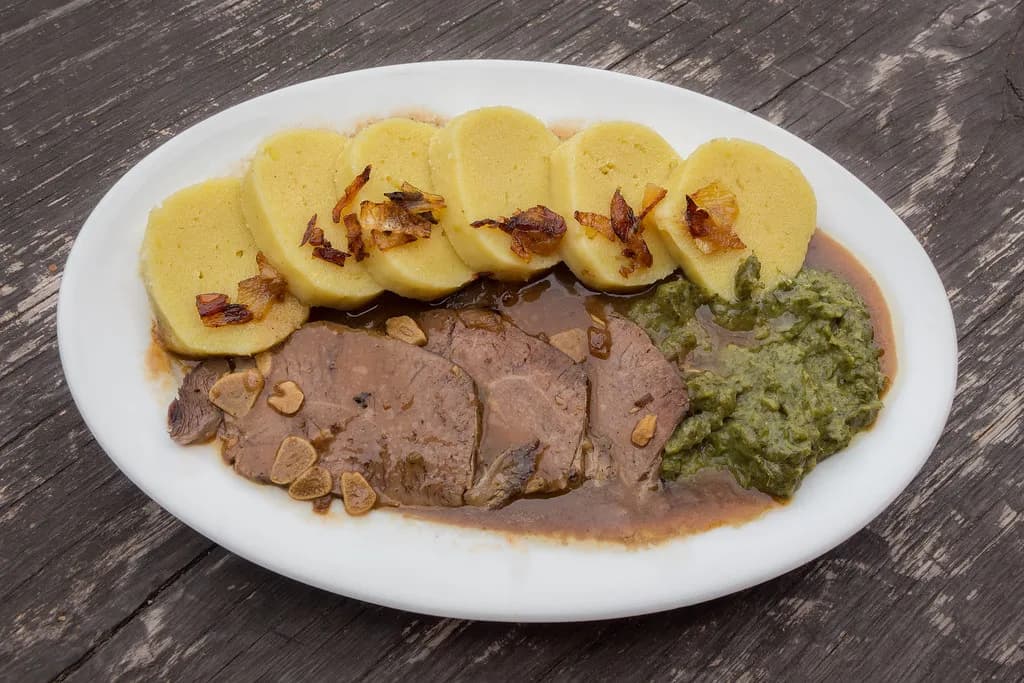
Start with svíčková, a beef dish in a cream sauce that Czech cooks serve with whipped cream and dumplings. Rajská follows the same idea in a tomato-based sauce, also with cream and a dumpling side. Neither is spicy; the flavor is mild, slightly sweet, and built to be soaked up by the bread dumplings.
Guláš is the other dish you will see on almost every menu, a thick meat stew with paprika and a sauce that works with bread dumplings. It is closely associated with Hungarian cooking but appears as a Czech classic in its own right. Order it when you want a darker, spicier plate than the cream sauces.
If you only order one plate, make it svíčková: it is the clearest introduction to the sauce-and-dumpling style that runs through the cuisine. Guláš is the better pick if you want a stew rather than a cream sauce. Both come with the same side question, which is whether you want bread dumplings, potato dumplings, rice, or potatoes.
How dumplings work: houskové knedlíky as a side, ovocné knedlíky as a sweet course
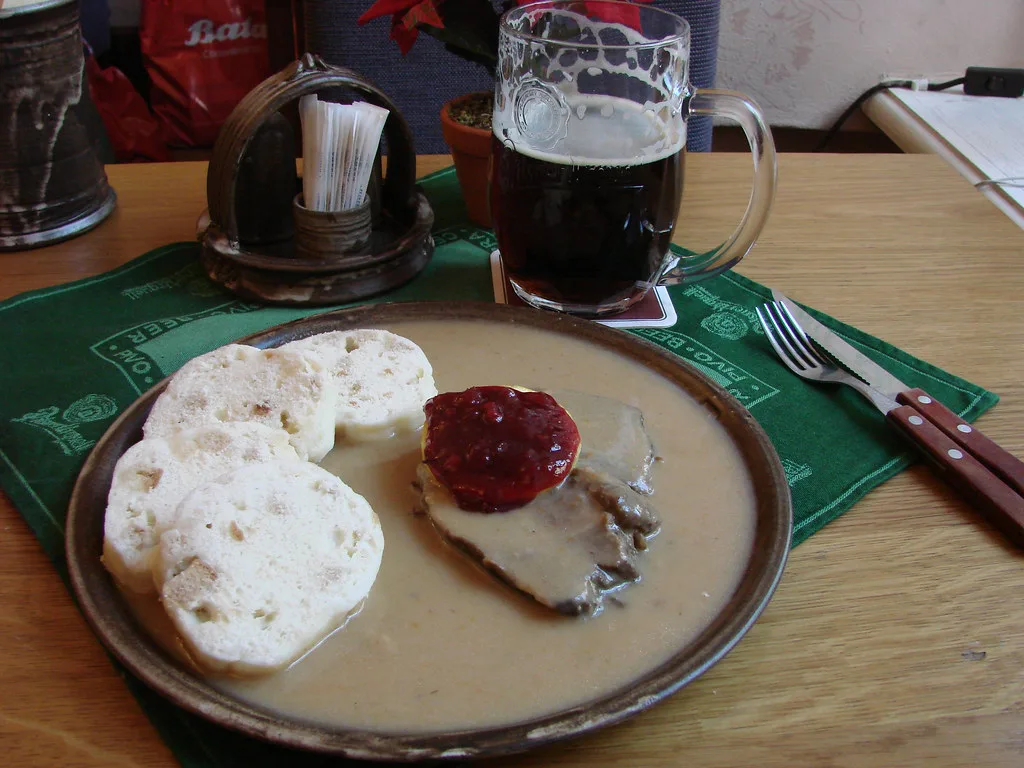
Knedlíky are not one food. Houskové knedlíky are the savory bread dumplings made from a wheat or potato flour dough, boiled as a roll and then sliced hot to sit beside meat and soak up sauce. Ovocné knedlíky are a separate sweet dumpling filled with fruit such as strawberries, apricots, or plums. Treat them as two courses, not two versions of the same thing.
Dumplings: Knedlíky are not one food. Houskové knedlíky are the savory bread dumplings made from a wheat or potato flour dough, boiled as a roll and then sliced hot to sit beside meat and soak up sauce.
Menus: A Czech menu is usually organized by the meat and sauce, with side dishes listed as choices rather than included by default. When you read a main, look for the sauce first, then the side options: dumplings, rice, or potatoes.
Vegetarians: Czech food is built on pork, beef, and dumplings, so a vegetarian will find fewer mains than in most Western European cuisines. The reliable options are fried cheese, potato dishes, and soups, provided the soup is not made with a meat stock.
A dumpling side is not a garnish. It is the carbohydrate that carries the sauce, and it is meant to be eaten with each bite of meat rather than before it. If a menu offers rice or potatoes instead, that is a real substitution, and the dish will taste lighter for it.
Sweet fruit dumplings usually arrive as a main course or a substantial dessert, topped with melted butter, sugar, and sometimes curd or whipped cream. They are soft, warm, and much less sugary than a US fruit pie. Save room, or order them as the meal itself.
Soups to start with: česneková polévka, cibulačka, gulášová polévka
Czech soups are a course worth ordering, not a forgotten extra. The two most appreciated are onion soup, cibulačka, and garlic soup, česneková polévka. Both are savory and direct, and they are a cheap way to start a meal without committing to a second heavy plate.
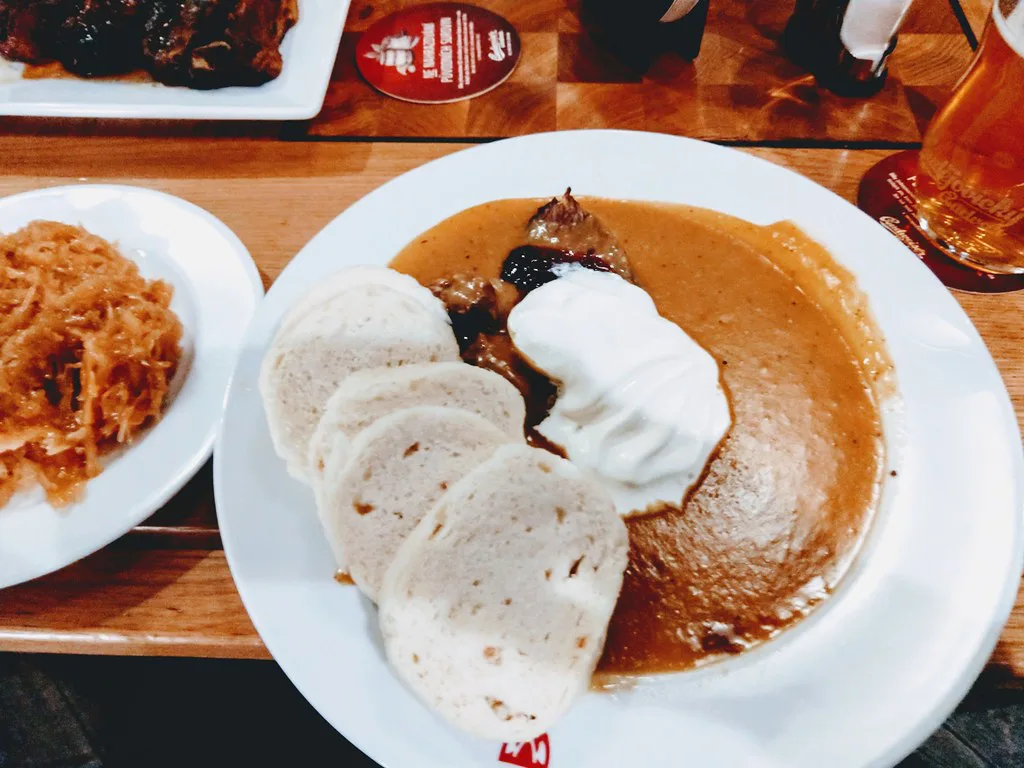
Gulášová polévka is a thick, spicy goulash soup served with brown bread, which makes it close to a small meal in itself. Order it on a cold day or when you want one dish rather than a main and a side. The other soup to know is rybí polévka, a carp fish soup tied to the Czech Christmas table rather than to everyday menus.
A practical order is one soup plus one main to share if you are traveling as a pair, because the mains are large and the dumplings fill in the rest. Czech salads, where they appear, are often mayonnaise-based and big enough to serve as a main course.
Schnitzel and fried cheese: smažený sýr with tartar sauce
Smažený sýr, fried cheese, is the plate to order when you want a break from sauce and dumplings. It is usually served with potatoes and tartarská omáčka, tartar sauce, and it sits on the menu as a main rather than a starter. Think of it as the Czech answer to a fried cutlet, not a light side dish.
Fried cheese is also the safest bet for a vegetarian at a meat-heavy restaurant, though it is fried and heavy. Czech menus make meat-and-dumpling plates easy to read and meat-free mains harder to find, so scan for the cheese and potato dishes before you sit down. Ask what the cheese is if the menu only says sýr.
If the menu lists a schnitzel, it will be a breaded cutlet in the Central European style, familiar to anyone who has eaten in Germany or Austria. It is a straightforward order and a good choice for a traveler who wants a break from cream sauces.
Pub food and beer snacks: nakládaný hermelín, utopenci, and klobásy
Czech beer snacks, pivní chut'ovky, form their own menu category and are often the most interesting things on a pub list. Nakládaný hermelín is a soft cheese marinated with oil, onion, and spices, made with hermelín, a cheese from Sedlčany that is close to camembert. It is served cold, usually with bread, and pairs with a beer rather than replacing a meal.
Utopenci, which translates as drowned, are sausages pickled in vinegar, oil, onion, red pepper, and spices, often made in-house at a pub. Klobásy are grilled sausages served with mustard, horseradish, and brown bread, and they show up both in pubs and at food stands. These are salty, sharp snacks, so order one or two rather than a full set.
The beer-snack tradition is worth planning for: order one plate with your first beer and decide from there. If you want a full meal, look for the menu section that lists mains rather than the snacks column. Pickled cheese and sausage plates are also the easiest way to share across a table.
The sauces with cream: what svíčková and rajská actually taste like
Svíčková is sweet-sour and creamy, closer to a gentle root-vegetable gravy than to a pepper steak sauce. Rajská is tomato-based and also finished with cream, so it reads as mild and rounded rather than acidic. If you are choosing between them, take svíčková for the classic plate and rajská when you want something slightly lighter.
Both sauces are designed to be eaten with bread dumplings, which absorb the cream and keep the plate from feeling rich in every bite. If you order rice or potatoes instead, the sauce will taste more concentrated. Neither dish is meant to be spicy, so do not expect heat from the cream plates.
Herbs and spices show up in these sauces in subtle ways rather than as a dominant flavor. Caraway, marjoram, and paprika are the words to recognize on a Czech menu, and they explain why a plate tastes warmer than its ingredients suggest. The cream sauces lean on mildness; the darker dishes carry the spice.
Desserts and bakes: palačinky, ovocné knedlíky, koláče
Palačinky are thin Czech pancakes filled with jam, fruit, or ice cream and topped with whipped cream, sugar, or almonds. Koláče are the round cakes and pastries filled with fruit, jam, or curd that appear in bakeries and on dessert menus. Both are simple and not overly sweet, which is the pattern across Czech baking.
Czech baking favors jam, fruit, and nut fillings over chocolate, and the results tend to be plain-looking but rich in texture. Linzer cookies are a good example of that style. If you see a pastry counter with fruit-topped rounds, those are the koláče to try with coffee.
For a warm dessert after a heavy main, order ovocné knedlíky or palačinky rather than a slice of cake. The fruit dumplings are the more distinctly Czech option, and they are less sweet than they sound. Skip the whipped cream if you want the fruit to come through.
Trdelník, the spit-roasted dough coil sold at stands in spa towns and castle towns, is a snack rather than a traditional dessert, so treat it as a walk-around treat between meals. It is sweet, warm, and easy to share. Buy one when you want something small rather than a sit-down course.
Flavor builders to recognize on a menu: caraway, marjoram, paprika, pickles, cabbage, mustard, dill
Czech flavors are built from a small set of pantry ingredients: paprika, pickles, cabbage, mustard, and dill, plus caraway seeds and marjoram, fresh or dried. Mushrooms, often foraged, appear in dishes too. Once you recognize these words, you can predict whether a plate will taste sharp, smoky, or mild before it arrives.
Cabbage and pickles are the acid in a meal that is otherwise meat and starch, so a plate with them will taste brighter than one without. Mustard and horseradish do the same job for sausages and cold plates. Dill and caraway are the quieter notes, usually in soups and sauces rather than on top.
Bread, potatoes, and dumplings are the starches that carry these flavors, and they appear in several forms: boiled, baked, fried, or sliced from a roll. That is why a Czech menu can look repetitive and still taste varied from plate to plate. Order by sauce and by side, and the differences become clear.
What to drink with it: Czech beer, slivovice, and the beer-snack culture
Czech beer is the default drink with a meal, and it is brewed to match food that is salty, creamy, and heavy. Pilsner-style lagers are the standard order, and a pub will usually list more than one. Order a small glass with a snack plate and a larger one with a main.
Slivovice is a Czech plum brandy drunk as an aperitif, a digestif, and everything in between. It is strong, so treat a pour as a small sip rather than a drink to nurse through dinner. If someone offers a homemade bottle, accept a taste and stop there.
Beer snacks and beer go together by design, and pubs often organize the menu around that pairing. Order a pickled cheese or sausage plate with your first beer, then decide whether you want a full main. Non-alcoholic drinks are widely available if you want the food without the alcohol.
Reading a Czech menu and lunch menu: how a main is priced and what a side dish means
A Czech menu is usually organized by the meat and sauce, with side dishes listed as choices rather than included by default. When you read a main, look for the sauce first, then the side options: dumplings, rice, or potatoes. The side is a real decision, not a formality.
At lunch, many restaurants offer a fixed midday menu with a soup and a main, which is the cheapest way to eat a full Czech meal. The trade-off is a narrower choice and a faster pace, so it suits a sightseeing day rather than a long dinner. The price is posted on the menu board at the entrance, so read it before you sit down.
Some menus list snacks under a heading like proti velké žízni i hladu, which signals food meant to go with beer rather than a full dinner. Read the section headings before ordering so you do not end up with three small plates and no main. If the menu is only in Czech, ask what the day's lunch plate is.
Ordering as a vegetarian or with restrictions
Czech food is built on pork, beef, and dumplings, so a vegetarian will find fewer mains than in most Western European cuisines. The reliable options are fried cheese, potato dishes, and soups, provided the soup is not made with a meat stock. Ask before ordering rather than assuming a dish is meat-free.
Potato pancakes and fried cheese are the two plates to look for, and both are filling enough for a main course. A mayonnaise-based salad can also work as a meal, but check whether it contains ham or sausage. If nothing on the menu fits, ask for a cheese or potato plate without meat.
For other restrictions, the main issues are cream in the sauces and pork in the soups and dumpling fillings. Say what you cannot eat plainly and ask what the kitchen can leave out. A lunch menu is harder to modify than an à la carte order, so choose the latter if you need changes.
Eating Czech food town by town: what changes as you leave Prague
The dishes stay familiar across the country, but the setting changes: a pub in a small town is more likely to serve a short menu of local standards than a long tourist list. Beer snacks are where regional variety shows up, since pubs make their own pickled sausage and cheese. Look for the house-made items first.
Away from Prague, lunch is still the main restaurant meal, and many kitchens close or narrow their menu between lunch and dinner. Plan a midday sit-down meal rather than assuming you can eat a full Czech dinner at any hour. Bakeries and food stands cover the gaps with pastries and grilled sausages.
In spa towns and castle towns, menus often add international dishes for visitors alongside the Czech standards. That is useful if you are traveling with someone who wants a break from dumplings. Order one Czech plate and one familiar one, and you get both.
Where Czech food sits next to German, Austrian, and Polish cooking
Czech flavors overlap with German, Austrian, and Polish cooking because the countries share borders and a pantry. Paprika, pickles, cabbage, mustard, and dill run through all four cuisines. If you know those kitchens, you already know the shape of a Czech plate.
The closest cousins are the breaded cutlet, the cream sauce with dumplings, and the pickled sausage, all of which appear in neighboring countries in some form. What is distinct is the combination and the proportion: more dumplings, more cream, and a shorter list of vegetables. Guláš sits at the Hungarian end of that shared repertoire.
For a US traveler, that means the food will taste familiar but heavier than expected. The flavors are not exotic; the portions and the starch are the surprise. Order a soup and share a main on your first Czech meal, then adjust.
What to order on your first Czech meal
Order svíčková with bread dumplings and a garlic soup for your first Czech meal, then try fried cheese or a beer-snack plate the next day. That sequence covers the cream sauce, the dumpling side, the soup course, and the pub culture without eating three heavy mains in a row.
If you are vegetarian, go straight to fried cheese or potato pancakes and ask about meat stock in the soup. Otherwise, build the meal around one sauce plate, one snack plate, and one beer, and you will have covered the core of Czech cooking.
Explore more Czech Republic guides
- Bramboráky
- Chlebíčky
- Czech Breakfast
- Czech Cheese
- Czech Christmas Cookies
- Czech Desserts
- Czech Dumplings
- Czech Goulash (Guláš)
- Czech Pastries
- Kulajda: Czech Dill and Mushroom Soup, Explained
- Medovník
- Svíčková na Smetaně
- Tatarak: Czech Beef Tartare, Served With Fried Bread and Garlic
- Utopenci
- Vepřo knedlo zelo
- Česnečka
- Řízek (Czech schnitzel)
- Czech Christmas Food
- Czech Street Food
Sources
Notes for your Czech trip
Optional updates to our Czech town guides.
You might also like


Continue reading
More guides you'll find useful