Czech Street Food: What to Order and How It's Served
Czech street food means grilled sausages, fried flatbreads, potato snacks on a stick, and the chimney cake trdelník. Here is what each dish is and how to order.
On this page
Czech street food is a small, specific set: the chimney cake trdelník wrapped around a spit and rolled in cinnamon sugar, potato chips on a stick, grilled and pickled sausages, and fried flatbreads from market stalls. The heavy dishes that show up on every Czech food list, pork knuckle and roast pork with dumplings, are knife-and-fork pub plates, not things you eat while walking. This guide covers what each snack is, how it is served, how to order and pay in koruna, and how stall food works away from Prague.
What Czech street food actually is: stall food versus pub plates
Stall and market food is built for one hand: something roasted on a spit, something fried and salted, something sausage-shaped in a bun with mustard. Pub plates are the opposite, served on a wooden board or a roasting tray with two mustards, grated horseradish, and bread on the side, as described for pork knuckle at Narodni Pivovar, a microbrewery next to the National Theater in Prague. Knowing which list a dish belongs to saves you from ordering a platter you cannot carry. For the full Czech repertoire, see the Czech Food guide.
The split matters for planning, too. Snacks are quick and portable, so they fit between a castle tour and a train, while pub dishes need a table and time. Most travelers end up eating both on the same trip, just not in the same hour.
Trdelník: the spit cake wrapped around a stick
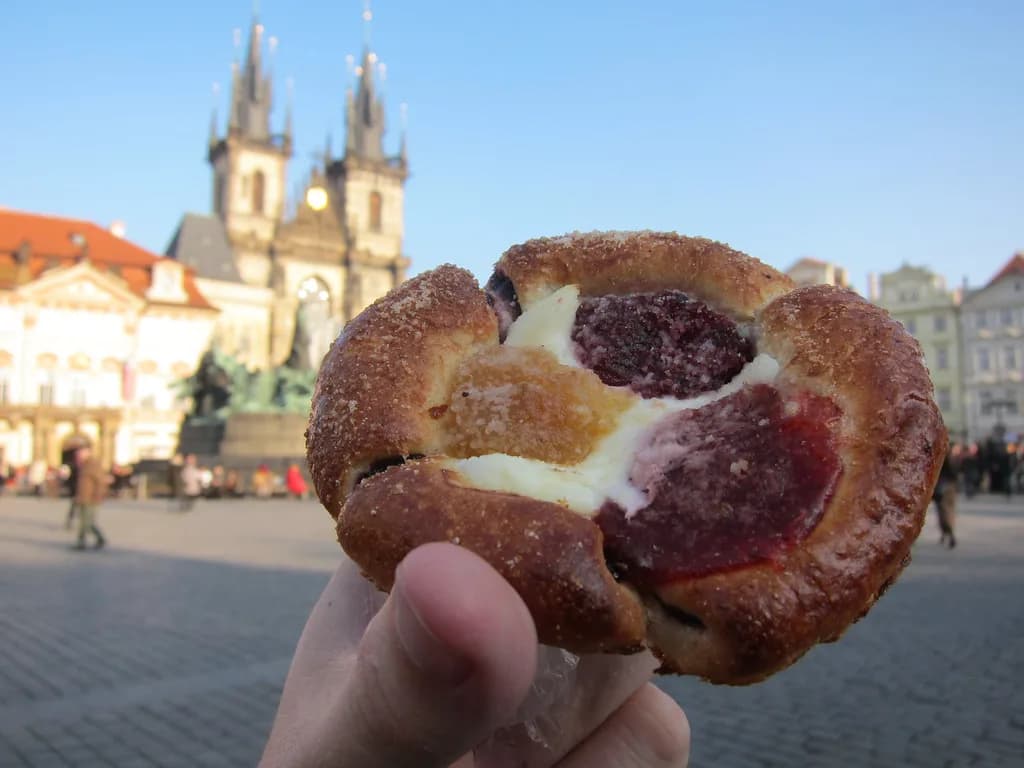
A trdelník starts as dough wrapped spirally around a stick, then held over an open flame until it turns golden brown and gets rolled in cinnamon sugar. Vendors sell it from street stands and cafés across Prague, and some bake savory and sweet versions with fillings such as strawberry and cream. The pastry is often called a Czech or Slovak delicacy, though it actually comes from Székely Land in Transylvania. For more on the cake itself, see the Trdelník guide.
Is trdelník actually Czech? It is sold as a Czech and Slovak specialty across Prague, but the pastry itself comes from Székely Land in Transylvania, as the source used in this guide explains. It is best treated as a popular street snack rather than a dish rooted in Czech tradition.
Can I eat pork knuckle as street food? No. Pork knuckle is served on a board or tray with mustards, horseradish, and bread, and it needs a table and a knife and fork.
Do I need cash for Czech street food? Carry some koruna in small notes and coins so a single sausage or a trdelník does not hold up the line, and check the posted price before you order.
Treat it as a warm snack to eat immediately rather than a souvenir; it softens as it cools. The filled versions are dessert-sized and messy, so grab napkins at the stand.
Why trdelník is sold on almost every corner in Prague
Trdelník is sold by street vendors throughout Prague, including on Karlova Street near Charles Bridge, where one traveler sampled the version at Good Food Coffee and Bakery. Spit cakes and other Czech street snacks also fill stock-photo libraries, which is a fair measure of how visible the pastry is to visitors. That visibility makes trdelník the default first purchase for many travelers.
If you want to try the pastry in a calmer setting, look for stalls on old town squares outside Prague, where you get the same cake with far less elbow room to fight for.
Sausages: grilled at stalls and pickled as utopenec
Grilled sausages with mustard and a slice of bread are the standard stall order, and they come in several sizes, so point at what you want and hold up fingers for quantity. The cold counterpart is utopenec, pickled sausages nicknamed drowned men, which keep in brine and turn up on pub cold plates alongside bread and onion rather than at a grill. Both are savory, salty, and best with a drink.
If you are building a picnic or a train lunch, utopenec travels better than anything hot: it is already cold and already preserved. Ask for it by name at a deli counter or a pub, and take a napkin.
Potato chips on a stick: what it is and where you see it sold
A spiral-cut potato is threaded onto a long stick and deep-fried, then salted, so it looks like a giant potato spring. It is sold at street stands and market stalls, and the appeal is as much the show as the taste. It is a snack, not a meal, and a shared portion works better than a solo one.
Fried flatbreads and grated-potato pancakes belong on the same walk-around list, hot from a griddle and eaten with your hands. For the sit-down version of the potato pancake, look for bramboraky on a pub menu.
Goulash and how it is served
Czech goulash is a thick, paprika-heavy beef stew served with bread dumplings, which makes it a sit-down dish rather than stall food. Order it when you want a proper meal in a pub, not when you are moving between sights. For more on the dish and its variations, see the Czech goulash guide.
The dumplings are the part that surprises first-timers: soft slices of steamed bread made for mopping the sauce. If you want to know what else appears alongside them on Czech plates, houskové knedlíky get their own treatment.
Pork knuckle: a pub plate, not a walk-around snack
Vepřové koleno is a whole roasted pork knee, usually marinated in dark beer and herbs, then served on a wooden board or in a roasting tray with two mustards, grated horseradish, and bread. At Narodni Pivovar in Prague it comes with a layer of crackling over tender meat and the traditional accompaniments, and the portion is easily shared. Ordering one alone and expecting to finish it is the usual mistake.
This is a dinner-sized plate, not a between-trains bite, so plan on splitting it if you are a smaller group.
Vepřo knedlo zelo: roast pork with dumplings and sauerkraut
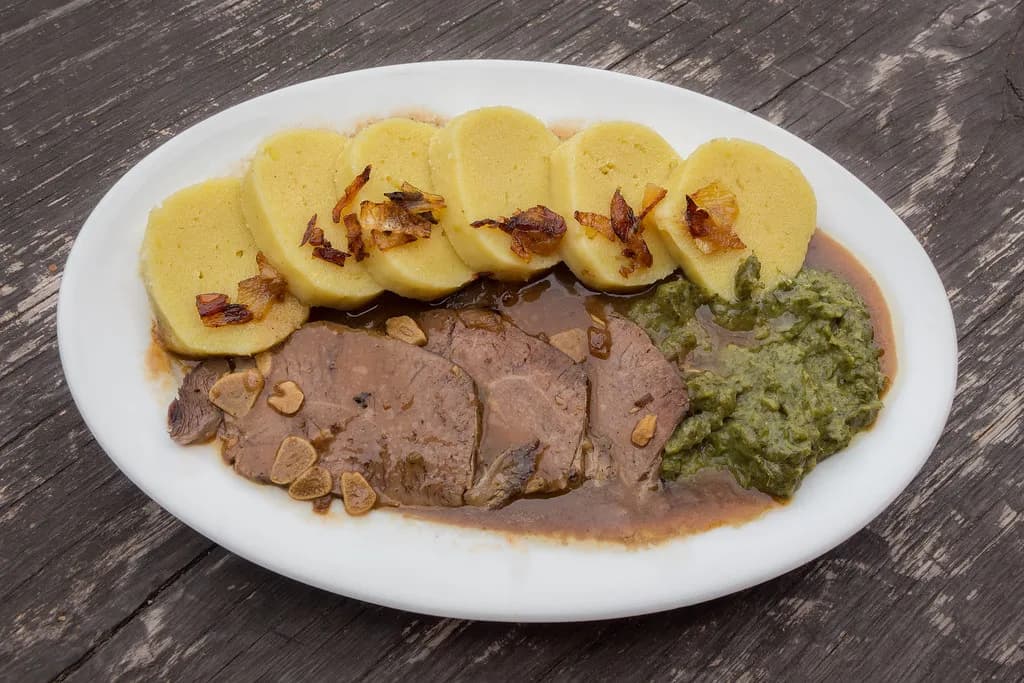
Roast pork with bread dumplings and sauerkraut is the classic Czech plate, milder than goulash and less theatrical than pork knuckle. It is a full meal with a knife and fork, served in pubs and restaurants rather than from a window. The dumplings here are the same soft bread slices you meet under goulash.
In a smaller town, this is the safe sit-down order: creamy, tangy, and easy to find on a lunch menu. For a cream-sauce alternative on the same list, Svíčková na Smetaně is the other classic plate.
Kofola and other drinks to order alongside street food
Kofola is the Czech cola-style soft drink, herbal and less sweet than the international brands, and it is what locals order with a sausage or a potato spiral. It is sold at stalls and in pubs, so it is the easy default when you are not sure what to ask for.
Pair a hot, salty snack with something cold and non-alcoholic and you can keep walking; a beer turns the same stop into a sit-down occasion. At a stall, ask for a bottle if you are taking it away.
How to order at a stall: pointing, portions, and paying in CZK
At a stall, the fastest route is to point at the item, hold up fingers for how many, and say prosím, then pay in koruna. Portions are large, so two people can share one potato spiral or one trdelník. Keep small notes and coins on hand for the cheapest snacks.
Check the price on the board before you order, and compare two or three stalls if you are on a busy tourist square.
Eating street food outside Prague: market squares, castle towns, and spa towns
The snack list travels well: trdelník, grilled sausages, and fried potato appear at market squares in old towns across the country, often in smaller crowds than in Prague's central streets. In castle and chateau towns, look for stalls near the main square, which makes them a practical lunch stop before an afternoon tour. For a look at the pastry in its many guises, see the Czech pastries guide.
Spa towns run to a different rhythm, with colonnade snacks and sweet pastries rather than sausage grills. If pastries are what you are after, Czech desserts are a separate, deeper subject.
What to skip if you want a proper meal
If the goal is a real meal, skip the long trdelník and potato-spiral lines and go straight to a pub lunch, where goulash, roast pork, and dumplings come with a table and a fork. Street food is best kept for the gaps between sights, not as a substitute for dinner. That is the practical split most travelers settle into after a day or two.
Stuffed chicken breast is another item on the traditional Czech food list when you want something lighter than pork. It shows up on ordinary lunch menus in towns outside Prague as well.
Which snack should you order first?
Start with a trdelník if you want something sweet and photogenic, or a grilled sausage and a Kofola if you want the savory, everyday version. Save the pork knuckle and goulash for a sit-down dinner, when you have a table and an hour.
Check the posted price at the stall before you order, since it varies from stand to stand on the same street. Carry some cash in koruna for the small purchases and you will not be caught out.
Explore more Czech Republic guides
Frequently Asked Questions
Is trdelník actually Czech?
It is sold as a Czech and Slovak specialty across Prague, but the pastry itself comes from Székely Land in Transylvania, as the source used in this guide explains. It is best treated as a popular street snack rather than a dish rooted in Czech tradition.
Can I eat pork knuckle as street food?
No. Pork knuckle is served on a board or tray with mustards, horseradish, and bread, and it needs a table and a knife and fork. Buy a sausage or a potato spiral instead if you want to keep walking.
Do I need cash for Czech street food?
Carry some koruna in small notes and coins so a single sausage or a trdelník does not hold up the line, and check the posted price before you order.
What is utopenec?
Utopenec means drowned man: a pickled sausage kept in brine, served cold with bread and onion as a pub or deli plate. It is the cold, preserved cousin of a grilled stall sausage.
Sources
Notes for your Czech trip
Optional updates to our Czech town guides.
You might also like


Continue reading
More guides you'll find useful