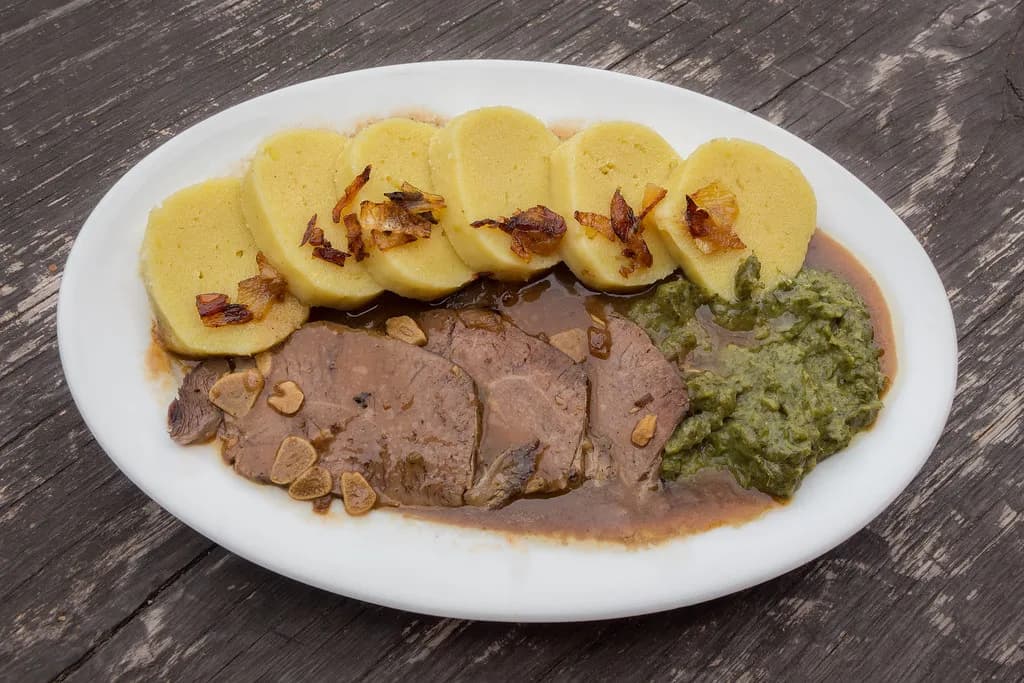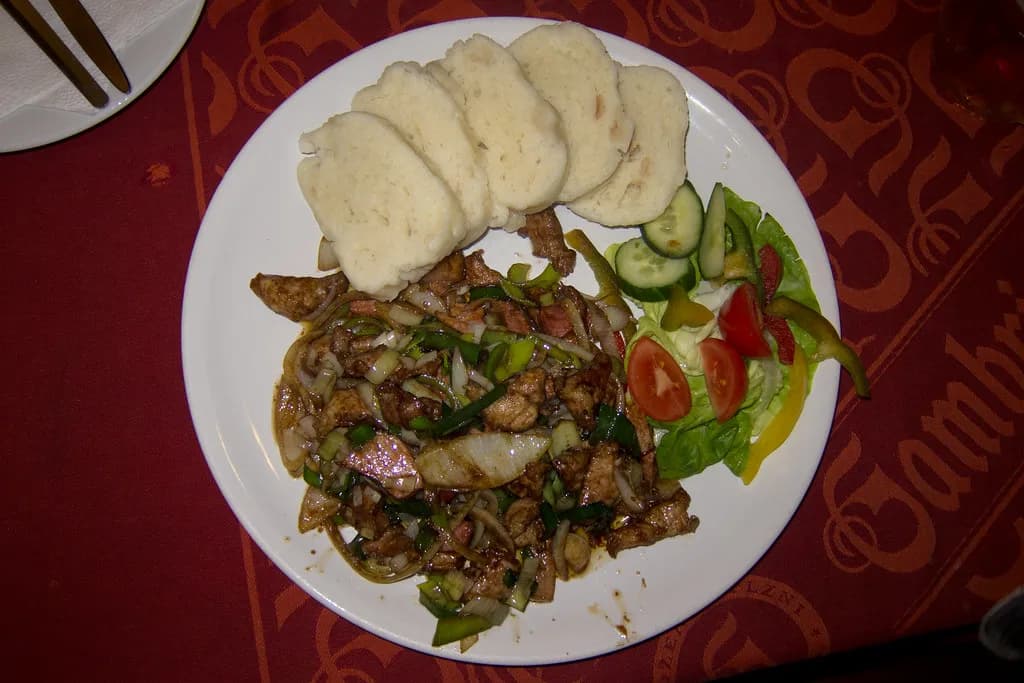
Czech Goulash: What Guláš Is and How to Order It
Czech goulash is a thick beef stew with onion and paprika, served with bread dumplings and raw onion. Here is what makes guláš different from Hungarian gulyás.
On this page
Czech goulash is a thick beef stew, not a soup, and it comes to the table with bread dumplings on the side and a crown of sliced raw onion. The Czech version is built on onions cooked down with sweet paprika, caraway and dried marjoram, then thickened until the sauce clings to the meat. This guide covers what guláš is, how it parts company with Hungarian gulyás, what goes into the pot, and what to expect when you order it in a pub.
One thing worth knowing before you sit down: the dish is a main course in the Czech Republic, hearty enough that it usually ends the meal rather than opening it. Menus list it as guláš or hovězí guláš, and the beef version is the standard. If a menu also offers gulášová polévka, that is the soup, a different and lighter item from the plate of stew.
What Czech goulash is
Hovězí guláš is beef cut into chunks and simmered slowly with a large quantity of onion until both break down into a dark, glossy gravy. The sauce is the point: Czech cooks reduce it until it is thick enough to sit on the plate, and some add a spoonful of flour at the end for a smoother texture that does not soak straight into the dumplings. The result is closer to a stew than to anything you would eat with a spoon from a bowl.
The dish belongs to the everyday repertoire rather than to festive cooking, sitting alongside Svíčková na Smetaně and rajská as a staple of Czech cuisine. That means you will meet it on pub menus across the country, from Prague to small towns. It is a good benchmark dish: if you eat only one traditional plate on a trip, this one tells you a lot about the kitchen.
Brown the onions and the meat properly at the start and the rest is mostly waiting. Recipes simmer the beef for two to two and a half hours, or about two hours in a simpler home version, until it gives way to a spoon. Ordering it in a pub, you are tasting the end of that process rather than a quick braise.
How Czech guláš differs from Hungarian gulyás
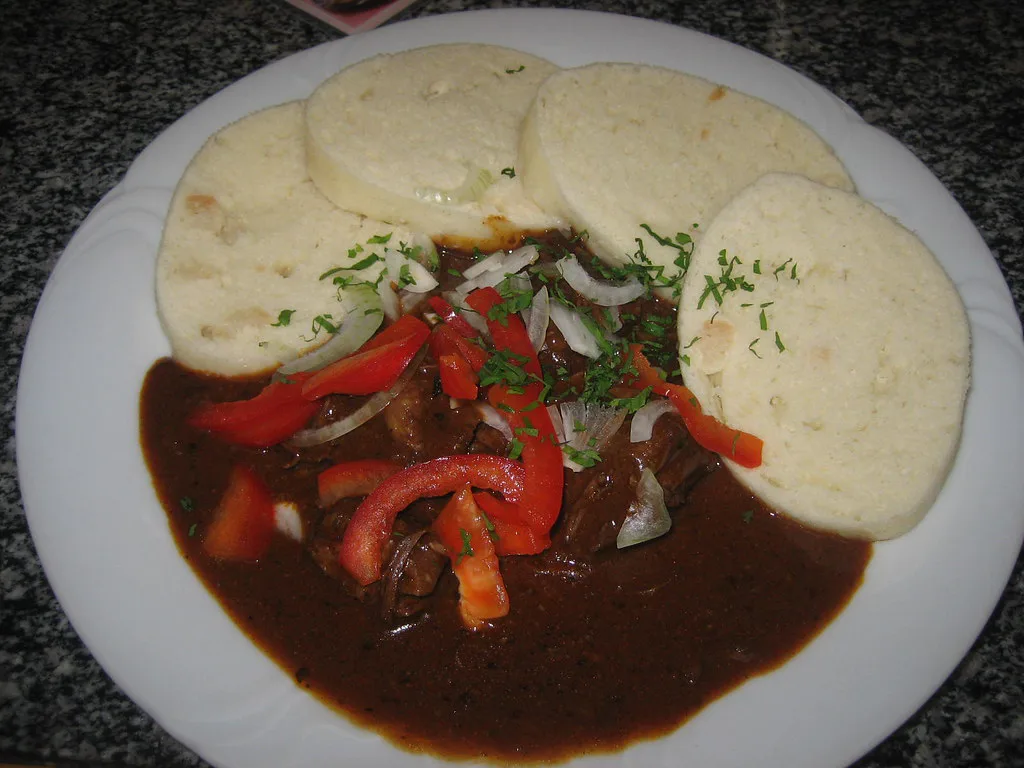
Hungarian gulyás is the original, and it is a thin soup of meat, peppers and potatoes with plenty of paprika. Many Hungarian versions are not thickened at all, which is why the first spoonful can feel surprisingly light compared with what arrives in a Czech pub. The Czechs took the idea and made it their own, keeping the paprika but pushing the dish toward a dense stew.
What is the secret ingredient in goulash? There is no single secret, but the Czech version leans on a large quantity of onion cooked down with the beef, plus caraway seeds and dried marjoram added late. Sweet paprika gives color and depth, and a little hot paprika can sharpen the sauce.
Is Czech goulash served as a soup or a stew? In the Czech Republic, guláš is a stew and a main course, served on a flat plate with bread dumplings and sliced raw onion. A menu may also list gulášová polévka, which is a separate soup.
The practical difference for a traveler is the plate. Czech guláš is a main course served with dumplings or fresh bread, while Hungarian gulyás behaves more like a soup course. Neither is a wrong turn, but do not order the Czech version expecting broth, and do not expect a Czech pub to bring you a bowl of the Hungarian kind.
Texture comes from the onions as much as from flour. Because the onion quantity is close to the weight of the beef, long cooking breaks it down and thickens the sauce naturally, which is why some cooks skip flour altogether and others use only a tablespoon. That onion base is also what makes the Czech dish sweeter and heavier than its Hungarian cousin.
What goes into a Czech goulash: beef, onions, paprika, caraway, marjoram
The cut matters less than the marbling: chuck, shank or round all work when cubed to roughly one inch or a little larger and cooked slowly. Czech cooks often reach for kližka, the shank, precisely because it holds up over a long simmer. Beef is the default, though pork appears in home versions and the dish tolerates it.
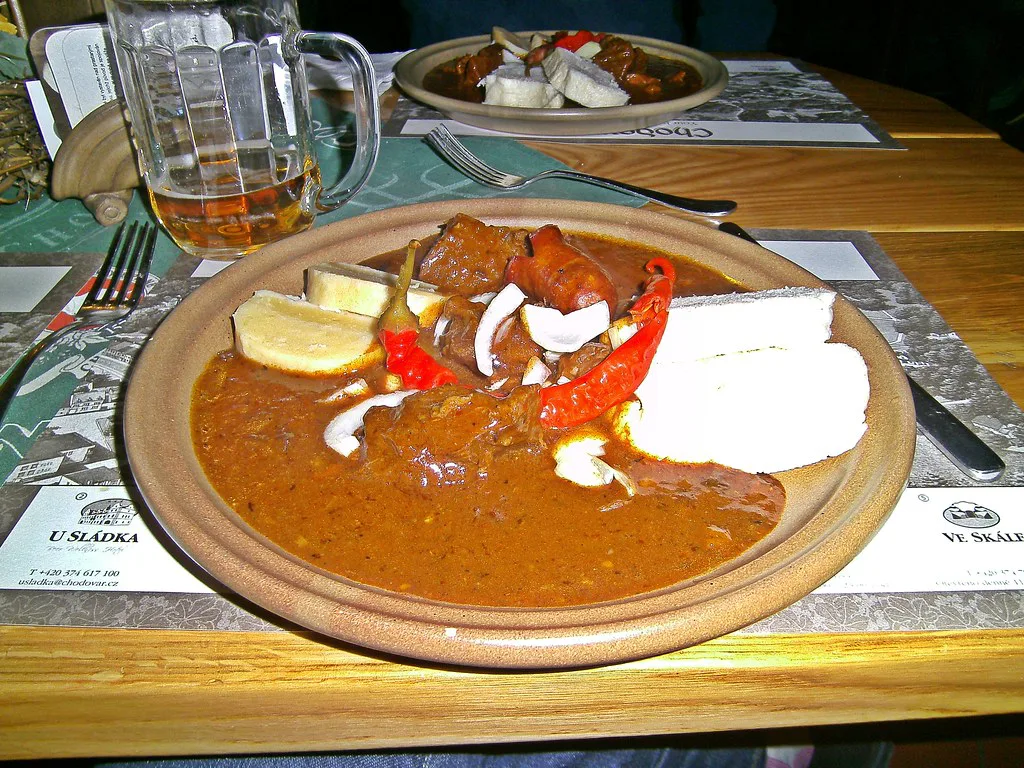
The flavor base is what separates a Czech guláš from a generic Central European stew. Sweet paprika supplies the color and the sweetness, crushed caraway adds an earthy note, and dried marjoram goes in near the end with fresh garlic. Tomato paste deepens the sauce, and bay leaves go into the pot during the simmer and come out before serving.
If you are cooking this at home, the onion-to-meat ratio is the single decision that shapes the result, and it is generous. Lard or sunflower oil is the traditional fat, and a teaspoon of hot paprika alongside the sweet kind gives the sauce a kick without overwhelming it. Skip the flour if you want the naturally thickened version, and accept a slightly looser sauce in exchange.
How it is served: bread dumplings, fresh bread, sliced onion, chilled beer
Czech guláš arrives on a flat plate with a slight lip rather than in a deep bowl, topped with rings of raw onion and often a sprig of parsley. Slices of bread dumplings sit alongside to mop up the sauce, and that pairing is the standard rather than an optional extra. If you want to understand the dumpling side of the plate before you go, the guide to houskové knedlíky covers the boiled slices you will meet here.
Fresh bread is the alternative to dumplings, and some kitchens will bring both. A glass of chilled Pilsner is the usual companion, and the beer cuts through the richness of the paprika and onion in a way water does not. Czech pubs commonly pour small and large sizes, so order the smaller one if you have a train to catch.
Portions are substantial, and the plate is a meal rather than a starter, so plan the rest of the table around it. If you are also ordering soup or a dessert such as ovocné knedlíky, consider sharing the stew or ordering it as your only main. That is a judgment about appetite, not a comment on quality.
How to order guláš in a Czech pub
Ask for guláš, or hovězí guláš if you want to be specific about beef. The dish is normally served with bread dumplings, which usually come with the stew, but confirm on the menu whether any side is charged separately. The word on the menu may be knedlíky. Pointing at a neighboring plate is a perfectly normal way to settle any question about what arrives.
The arrival is the moment to reset expectations: a flat plate, dark red-brown stew, raw onion on top, dumpling slices at the edge. Eat the onion with the meat rather than pushing it aside, since it is there to cut the richness.
If the menu lists gulášová polévka, that is the soup version and a lighter, cheaper order, useful at lunch when you want something smaller. It is not the same dish as the plate of stew, so read the Czech words rather than assuming a translation. Prices vary by town and by venue, and menus in the window or on the table are the honest source before you sit down.
Where to eat it: Kutná Hora's Restaurace Dačický and other stops on a Czech Byways route
Kutná Hora is a natural stop for guláš, and Restaurace Dačický there is the restaurant whose plate inspired a home cook's souvenir from the town. The name honors Mikuláš Dačický, a sixteenth-century Czech writer, and the plate carries a Czech phrase along its rim. Treat it as a name to look for while you are in town rather than as a reservation you must build a day around.
Beyond Kutná Hora, the dish is standard pub fare, and a lunch of guláš and dumplings fits neatly before an afternoon at a castle or a chateau, since the meal is quick. Order it where the room is full of local diners rather than at a place that feels aimed only at visitors.
For a fuller picture of what to eat alongside it, from dumplings to pastries, the Czech Food guide on this site maps the dishes worth planning a stop around. Guláš is the anchor, but a trip built only on stew misses the desserts and the soups that make Czech cooking distinctive.
Storing and reheating leftover guláš
Guláš improves overnight, and leftovers keep in a covered container in the refrigerator for up to four days. Reheat gently and stir, adding a splash of water if the sauce has thickened too far, since the gravy tightens as it cools. That makes it a sensible dish to cook in quantity at home and eat across a week.
It freezes well for about three months at best quality, and thawing completely in the refrigerator before reheating keeps the texture intact. Dumplings are the weak point: freeze the stew on its own and boil fresh dumplings or slice bread when you reheat. The sauce survives the freezer far better than the starch does.
If you are cooking in a rented apartment, make it a day ahead and reheat it for a second meal, when the flavors have had time to settle. A single pot feeds several people without much equipment beyond a heavy pan. That is one of the reasons the dish travels so well from pub kitchen to home kitchen.
What to Order at the Pub
Order the hovězí guláš with bread dumplings, take the raw onion on top, and add a small Pilsner if you are not driving. Expect a thick, dark, paprika-heavy stew rather than a soup, and read the Czech menu so you do not end up with the lighter gulášová polévka by mistake.
Save the dish for a town where you are already stopping for a castle or an old square, since the meal is quick and fits a midday break. Kutná Hora is the obvious pairing, and Restaurace Dačický is the name to look for there. Menus and prices change, so read what the venue itself posts before you commit to a table.
Explore more Czech Republic guides
Frequently Asked Questions
What is the secret ingredient in goulash?
There is no single secret, but the Czech version leans on a large quantity of onion cooked down with the beef, plus caraway seeds and dried marjoram added late. Sweet paprika gives color and depth, and a little hot paprika can sharpen the sauce. Slow simmering for around two hours is what turns those ingredients into a thick gravy.
Is Czech goulash served as a soup or a stew?
In the Czech Republic, guláš is a stew and a main course, served on a flat plate with bread dumplings and sliced raw onion. A menu may also list gulášová polévka, which is a separate soup. If you want the plate of stew, order guláš or hovězí guláš rather than the soup.
Sources
Notes for your Czech trip
Optional updates to our Czech town guides.
You might also like



Continue reading
More guides you'll find useful