Czech Villages: Rural Towns Worth a Stop Beyond Prague
Czech villages reward a detour for painted farm squares, wooden towns and open-air museums. Here is how each rural stop fits a route from Prague.
On this page
Czech villages are worth a stop when you pick the right kind: a living settlement with a protected square, a small town of wooden houses under a tower, or an open-air museum that reassembles farm buildings and furnishes them. Each delivers something a castle town cannot, because the point is the ordinary built landscape rather than a noble family's showpiece. This guide covers the villages and museum sites that repay the detour, then works out how they fit a route from Prague toward Český Krumlov, Brno or the Pilsen region.
Plan on the stop costing you a half day rather than an hour. Village sights sit off the fast rail corridors, regional buses thin out in the afternoon, and museums keep their own seasons. Treat transport as the binding constraint and the architecture as the reward.
What a Czech village stop gives you that a castle town does not
Castle towns organize a visit for you: one gate, one ticket office, one guided circuit. A village asks you to read a square, a farmyard gate and a chapel on your own terms, and that is exactly the appeal. You see how rural Bohemia and Moravia actually built, in stone, timber and stucco, at a scale no chateau reproduces.
The trade-off is that villages offer fewer services and less English. A castle town has cafés and signage around its landmark; a village may have one inn and a noticeboard in Czech. Carry water and snacks, and know your return bus before you arrive, because the last connection often leaves in the late afternoon.
Holašovice: the UNESCO farm square and its rural baroque gables
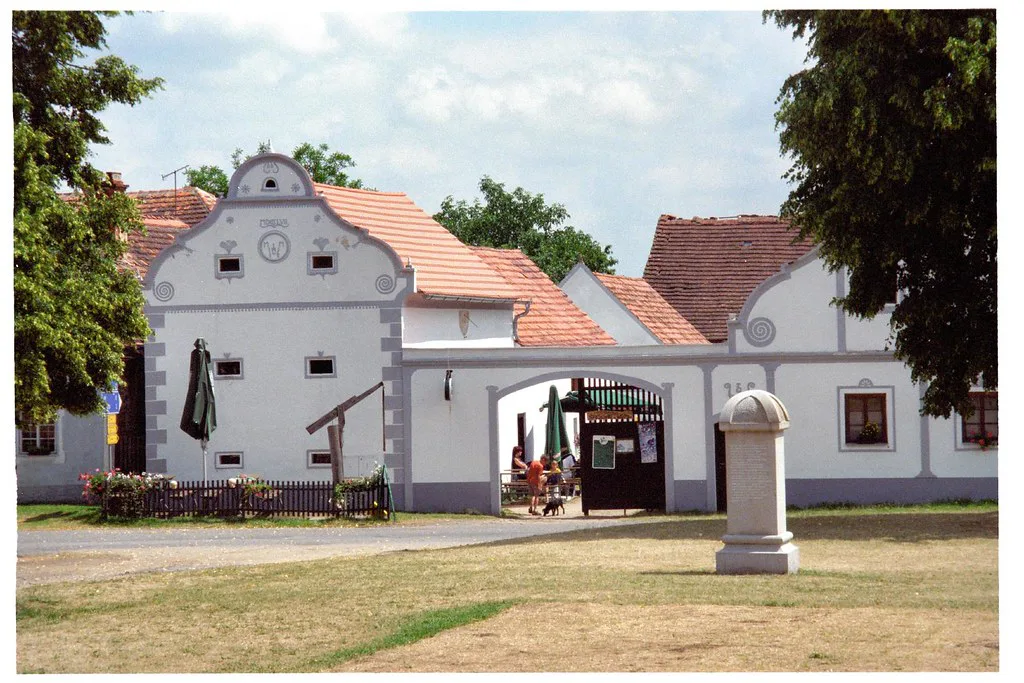
Holašovice is the clearest example of a village you visit for its architecture rather than for its museum. The settlement is a living working village in South Bohemia whose farmsteads line a rectangular green, their facades carrying the rounded, white-rendered gables of what is usually called rural baroque. UNESCO lists the square for exactly this ensemble, so the thing to do is walk the perimeter slowly and look up at the gable shapes.
Do you need a car to see Czech villages? No, but a car makes it far easier. Villages such as Holašovice and Slavonice sit off the fast rail corridors, so the usual pattern is a train to the nearest town with a station and then a regional bus or taxi.
Is Holašovice a museum? No. Holašovice is a living village whose farm square is protected for its rural baroque gables and inscribed on the UNESCO list.
What is the best time of year for a village stop? Spring and fall give you the best conditions for the forest sites in particular, because vegetation hides the remains of former settlements less once the leaves are down. Village squares are open all year, but small museums and chateau interiors keep seasonal calendars, so confirm the opening day before you build a route around one.
Understand what you are visiting: this is not an open-air museum with reconstructed cottages and an entry gate. People live behind those gables, gates stay shut, and there is no staged interior to tour. That shapes the visit, so keep to the lanes and the green, and expect a short stop of an hour or two unless you have come specifically for the architecture.
Holašovice sits in the South Bohemian countryside within reach of České Budějovice (Budweis), which makes it a natural pairing with a longer southern route. Buses and trains run to nearby villages rather than to the green itself, so the practical approach is a regional bus or a car with a short final walk. Check the operator's current timetable for the day you travel, since rural service is thin on weekends.
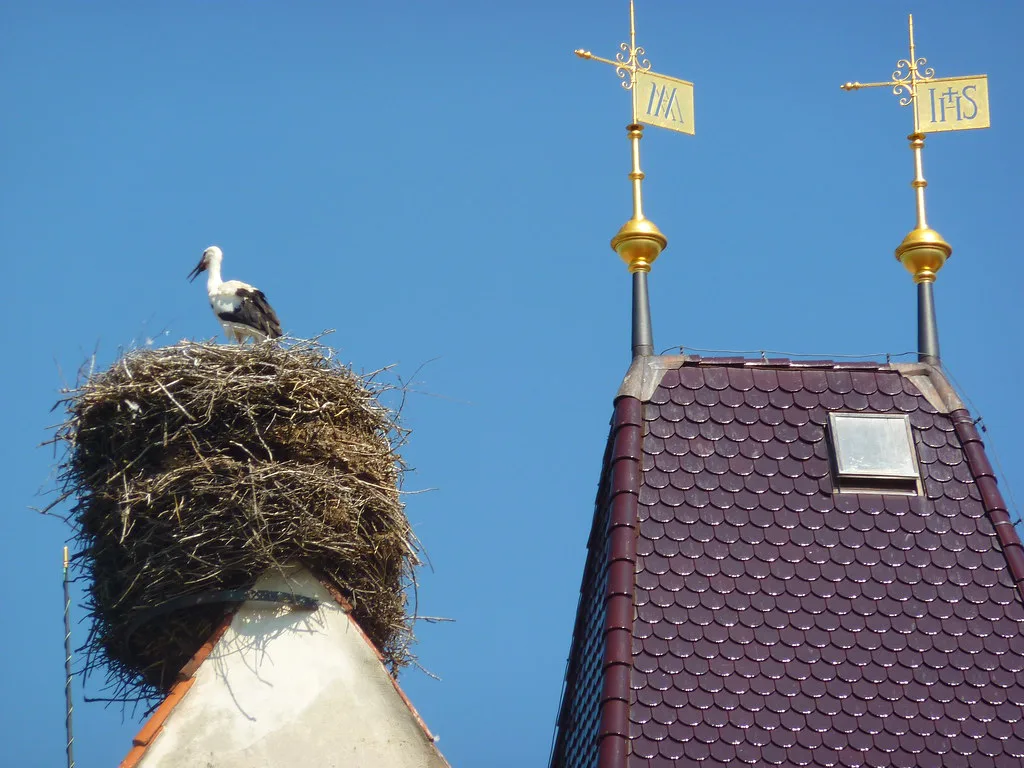
Štramberk: wooden houses under a round tower in Moravia
Štramberk in Moravia is a small town rather than a scattered village, and it squeezes wooden-walled houses onto slopes below a stone round tower known as Štramberská Trúba. The effect is a compact old core you can cover on foot, with lanes that climb and views that open as you go. It pairs well with the larger Moravian cities on a Brno-based route.
The tower is the landmark that gives the town its shape, and the streets below it are the reason to linger. Because the core is small, an afternoon covers the lanes and the viewpoints without rushing. Arrive earlier in the day if you want the lanes quieter, since a compact old town fills quickly once tour groups reach it.
Štramberk rewards travelers heading east rather than south. It works as a break between Brno and the Beskydy foothills, and its scale suits a half-day rather than an overnight. Regional trains and buses serve the surrounding area, but connections from Prague are long, so build the stop into a Moravian leg instead of treating it as a day trip from the capital.
Slavonice: a small town of Renaissance facades on the Bohemian-Moravian border
Slavonice sits close to the Bohemian-Moravian border, and its old center preserves a run of Renaissance and later facades around a long square. It reads as a town rather than a village, but the scale is small enough that the historic core is a single continuous walk. The town's position makes it a natural pause on routes between South Bohemia and Moravia.
What distinguishes Slavonice from a village green is density: rows of burgher houses with decorated fronts, cellars beneath them and a compact street plan. You are looking at urban building on a rural scale, which is a different pleasure from Holašovice's farmyard gables. Budget a couple of hours for the center and keep the rest of the day for the road.
Slavonice suits travelers already moving between South Bohemia and Moravia by car or regional bus. There is no fast rail line to build a trip around, so the town works best folded into a longer drive rather than targeted from Prague.
Open-air museums at Rožnov pod Radhoštěm and Strážnice: village buildings rebuilt and furnished
Open-air museums are the other way to see Czech village architecture, and they solve the problem Holašovice poses. At Rožnov pod Radhoštěm in the Zlín Region, timber houses, churches and farm buildings have been moved to a museum ground and furnished, so you can step inside rather than admire a closed gate. This is a museum visit with ticket desks, paths and interpretation, not a stroll through a working village.
Strážnice in southern Moravia follows the same logic, gathering vernacular buildings into a museum setting where folk culture and craft are part of the presentation. Choose a museum when you want interiors, labels and a defined opening season, and choose a living village when you want the real square in its landscape. Both are legitimate, and they are not substitutes for one another.
Museum sites operate on their own calendars, which matters more than at a castle. Buildings that open for the warm season close or shorten hours outside it, and some interiors are shown only with a guide or at set times. Check the museum's own site for the day you plan to go, and build your route around its confirmed season rather than the other way round.
Grandmother's Valley at Ratibořice: the landscape behind Němcová's novel
Grandmother's Valley, Babiččino údolí, near Česká Skalice in eastern Bohemia is a protected valley associated with Božena Němcová's novel Babička, one of the foundational texts of Czech national culture. Visitors come for the combination of a wooded river valley, a chateau at Ratibořice and the folk buildings tied to the book. It is landscape and literary heritage together, which no single museum building reproduces.
Treat the valley as a walk through a cultural landscape rather than a ticketed attraction with one entrance. The chateau and the associated buildings keep their own visiting arrangements, so plan the walk first and the interiors second. Paths are gentle enough for a half day, and the setting rewards anyone who wants rural Bohemia with a story attached.
Česká Skalice is the practical base and rail access point for the valley, which puts the area on a route between Prague and the eastern Bohemian border country. It is a dedicated detour rather than a roadside pause, so give it a night or a full day rather than squeezing it between two castle tours.
Bohemian Forest abandoned villages: Lučina and the trails through former settlements
Not every Czech village stop is about preservation. In the border forests of the Bohemian Forest, dozens of villages and settlements disappeared after World War II, when the original inhabitants were expelled, a strictly guarded border zone was established and many buildings were demolished. What remains are wall fragments, overgrown foundations, old wells, small ponds, crosses and mature trees that once stood in village centers. The Pilsen Region's tourism board describes these places as a landscape that has not vanished without a trace.
The most striking site is Lučina, also known as Grafenried, near Nemanice. Remains of a church, school, inn, brewery and other buildings have been uncovered there, and an educational trail leads visitors through what was once the heart of the village. Pleše, Bystřice and Křížová Huť are among the other former settlements scattered through the forest, and each rewards a slower, quieter kind of attention.
This is not conventional sightseeing, so adjust expectations. The tourism board notes that the atmosphere is best revealed in spring and fall, when vegetation obscures the remains less. Wear shoes for forest paths, allow more time than the map suggests, and treat the walk as a sober encounter with twentieth-century history rather than a photo stop.
Reading village architecture: farmyard layouts, chapels, bell towers and village greens
Once you have seen two or three villages, the vocabulary becomes readable. A South Bohemian farmstead often turns its living quarters and barns around a courtyard behind a wide gate, with the decorated facade facing the green. The green itself, a broad open rectangle, is the organizing space, and the chapel or bell tower usually sits at one end or beside the pond.
Look for the bell tower or chapel as a marker of the village center, and notice whether the houses present their decorated fronts to the square or turn their working sides outward. Rural baroque gables, timber log walls and painted stucco tell you which region and which century you are in. That reading habit turns a quick pause into a real visit.
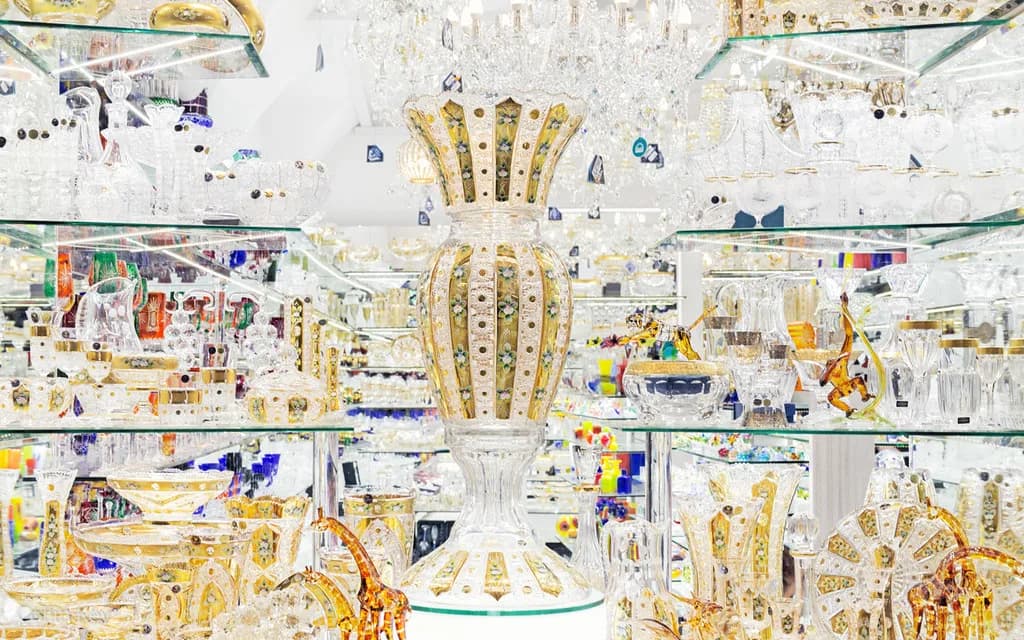
Two craft traditions belong to the same rural world and fill the gaps between village stops. Bohemian crystal and lead crystal made in the glassmaking regions to the north are the industrial counterpart to village craft, and the country's brewing tradition, from small town breweries to Pilsner Urquell, grew out of the same agricultural economy. Save both for the stretches of road between villages.
How to reach Czech villages from Prague by train, bus or car
Prague is the hub for almost every route, but few villages have a station worth planning around. The workable pattern is a train to the nearest town with a station, then a regional bus or a taxi for the final stretch. Where a village lies on a rail line, as around České Budějovice, the trip is simple; where it does not, the bus timetable decides your day.
A car removes the timetable problem entirely and is the reason so many travelers combine three or four village stops in one loop. If you are driving, plan the order by geography rather than by fame, and keep the furthest village for the middle of the day when light and services are best. If you are relying on buses, pick one village per day and confirm the return connection before you set out.
The Czech Republic is compact, and towns are close together on the map, which makes over-planning the common error. A loop that touches too many places in a day produces exactly the midday arrival you want to avoid.
Fitting villages into a route toward Český Krumlov, Brno or the Pilsen region
Southbound routes toward Český Krumlov pass through the South Bohemian countryside where Holašovice sits, so a village stop costs you little in extra miles. Take the village in the morning and reach the bigger town later, which puts you ahead of the coach traffic that thickens at midday. This is the easiest village to fold into an existing itinerary.
Eastbound routes toward Brno open up Moravian options, with Štramberk in the north, Strážnice in the south and Slavonice on the western approach. Brno is the practical hub for this cluster, and it is the second-largest city in the country, so you can reset with a proper meal and a bed between village days rather than chaining rural stops.
Westbound routes toward Plzeň (Pilsen) serve the abandoned villages of the Bohemian Forest, which sit far enough south and west that they work best as a dedicated half day from a regional base. Plzeň itself is a useful start for that leg, and it puts the Pilsen Region's forest trails within reach without a punishing drive.
Costs in CZK and what a village visit actually takes in time
A living village costs nothing to walk. Holašovice, Slavonice and Štramberk's lanes are open public space, so the money goes on transport and food rather than entrance fees. Bring Czech koruna in cash for small village inns and bus drivers, since card readers are not universal outside towns.
Museums and chateaux charge admission, and their published price lists are the only reliable figure because tariffs change between seasons. Rather than budgeting from a guidebook, check the venue's own site for the current ticket price in CZK before you commit to a day. A family visit to an open-air museum costs meaningfully more than a walk around a village green.
Time is the harder currency. A village core takes one to two hours, an open-air museum takes three or more, and the valley at Ratibořice fills a half day with the walk. Add the journey each way, and one village plus one museum is a full day's program rather than a light add-on.
Where village stops go wrong: limited transport, closed museums and midday coach traffic
The first failure is transport optimism. Regional buses run a handful of times a day on many rural lines, and weekend service is thinner still, so a missed connection can strand you. Read the timetable before you go and keep a fallback plan that returns you to a town with more options.
The second is assuming everything is open. Small museums and chateau interiors at village sites often keep seasonal hours and close on certain weekdays, and a locked building can wipe out the reason for your trip. Confirm the opening day before you travel rather than after you arrive.
The third is arriving at midday. Holašovice and the popular South Bohemian stops draw coach groups in the middle of the day, and a village green with a tour group on it feels very different from an empty one. Go early, or go late, and the same place gives you the quiet that made you choose it.
Which village to build your day around
Choose by what you want to see. For a living farm square with painted gables, build a South Bohemian day around Holašovice. For furnished interiors and a defined museum visit, pick Rožnov pod Radhoštěm or Strážnice. For wooden houses under a tower on a Moravian route, Štramberk is the compact choice, and Slavonice covers the border country on the way.
If you have a car and a spare half day in the west, the abandoned villages near Nemanice and the educational trail at Lučina are the most affecting stop on this list, precisely because so little is left to see. Whichever you choose, hold the visit to one village or one museum a day and let the transport, not the wish list, set the pace.
Explore more Czech Republic guides
Frequently Asked Questions
Do you need a car to see Czech villages?
No, but a car makes it far easier. Villages such as Holašovice and Slavonice sit off the fast rail corridors, so the usual pattern is a train to the nearest town with a station and then a regional bus or taxi. That works, but the sparse rural timetable dictates your day, which is why many travelers drive when they want to link several villages in one loop.
Is Holašovice a museum?
No. Holašovice is a living village whose farm square is protected for its rural baroque gables and inscribed on the UNESCO list. The houses are people's homes, gates stay closed, and there is no ticket office or staged interior. If you want furnished buildings and labels, choose an open-air museum such as Rožnov pod Radhoštěm or Strážnice instead.
What is the best time of year for a village stop?
Spring and fall give you the best conditions for the forest sites in particular, because vegetation hides the remains of former settlements less once the leaves are down. Village squares are open all year, but small museums and chateau interiors keep seasonal calendars, so confirm the opening day before you build a route around one.
Sources
Notes for your Czech trip
Optional updates to our Czech town guides.
You might also like
Continue reading
More guides you'll find useful