Czech Castles Worth Planning a Route Around: Tickets, Tours and Seasons
Czech castles are mostly seen on timed guided tours priced in koruna. Here are the castles worth a route, what each circuit reaches and the Monday rule.
On this page
Plan Czech castles around circuits, not postcodes: a single castle can sell several separately priced tours, and the cheapest ticket often skips the room you came for. Almost all the big state properties are seen on a timed guided tour of the interiors, priced in Czech koruna, so the route you buy matters more than the castle you pick. This guide covers the castles worth building a trip around, their circuits and CZK prices, the seasons that govern them, and how they fit a route from Prague or Brno.
Two rules settle most planning questions. State castles close on Mondays, and interiors shut for the winter, usually reopening at weekends in April and going daily from May. Exteriors, gardens and parks often stay accessible outside those hours, which is why a Monday in Český Krumlov still works if you treat the castle as a walk rather than a tour.
What a Czech castle visit actually involves
Czechia counts more than 2,000 castles and chateaux, and most of the headline names are state-run, which shapes the visit: you do not wander the furnished rooms. You join a group at a fixed departure, follow a named circuit, and hear the commentary in Czech unless an English tour is offered and booked. Tickets are published in koruna rather than euros, so budget in CZK and treat any euro figure you see elsewhere as a conversion, not a price.
That structure is an advantage once you understand it: tours are named and priced separately, so you can choose the apartments, the chapel or the tower instead of walking every room in order, and reduced rates for children, students and seniors are published alongside the adult fare. The trade-off is time: a circuit ties you to a departure slot, which is why one castle done properly beats three done from the parking lot.
The three castles that fit a first Czech trip
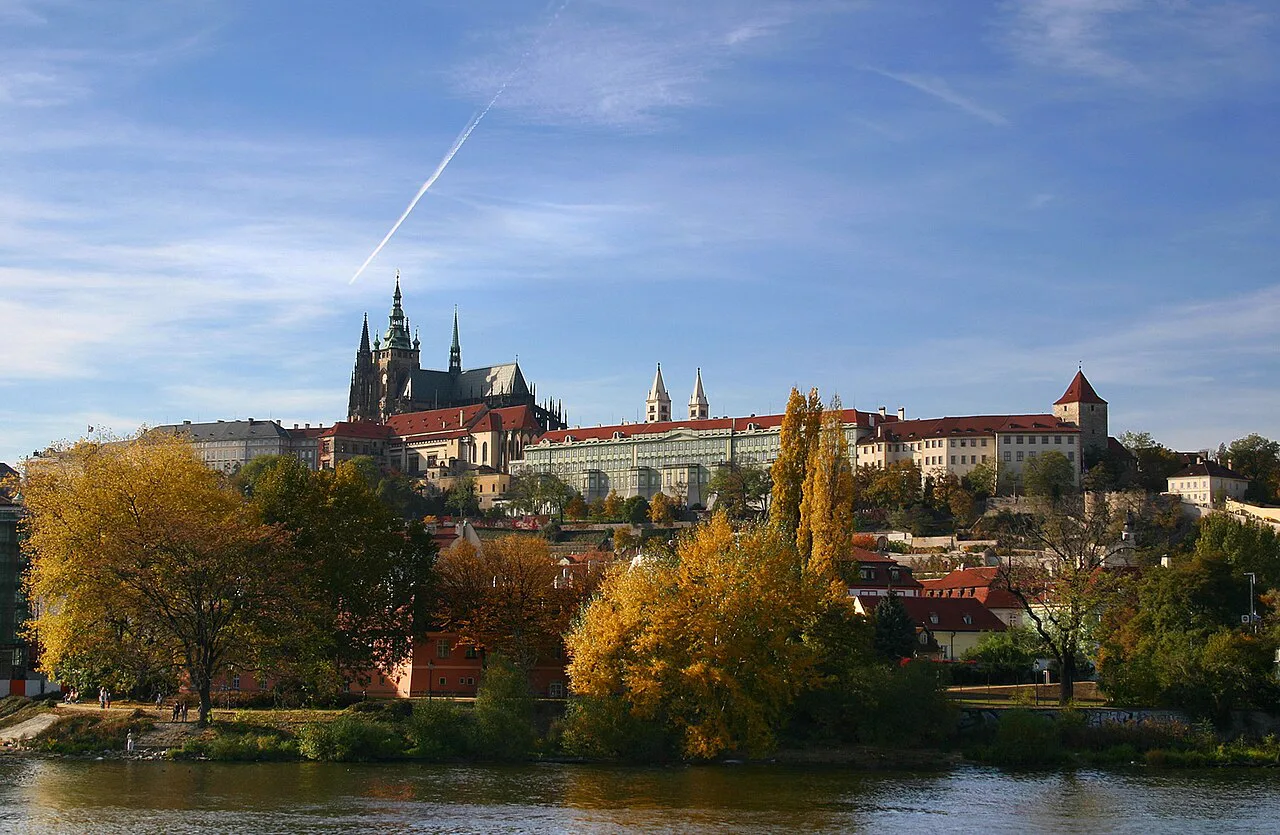
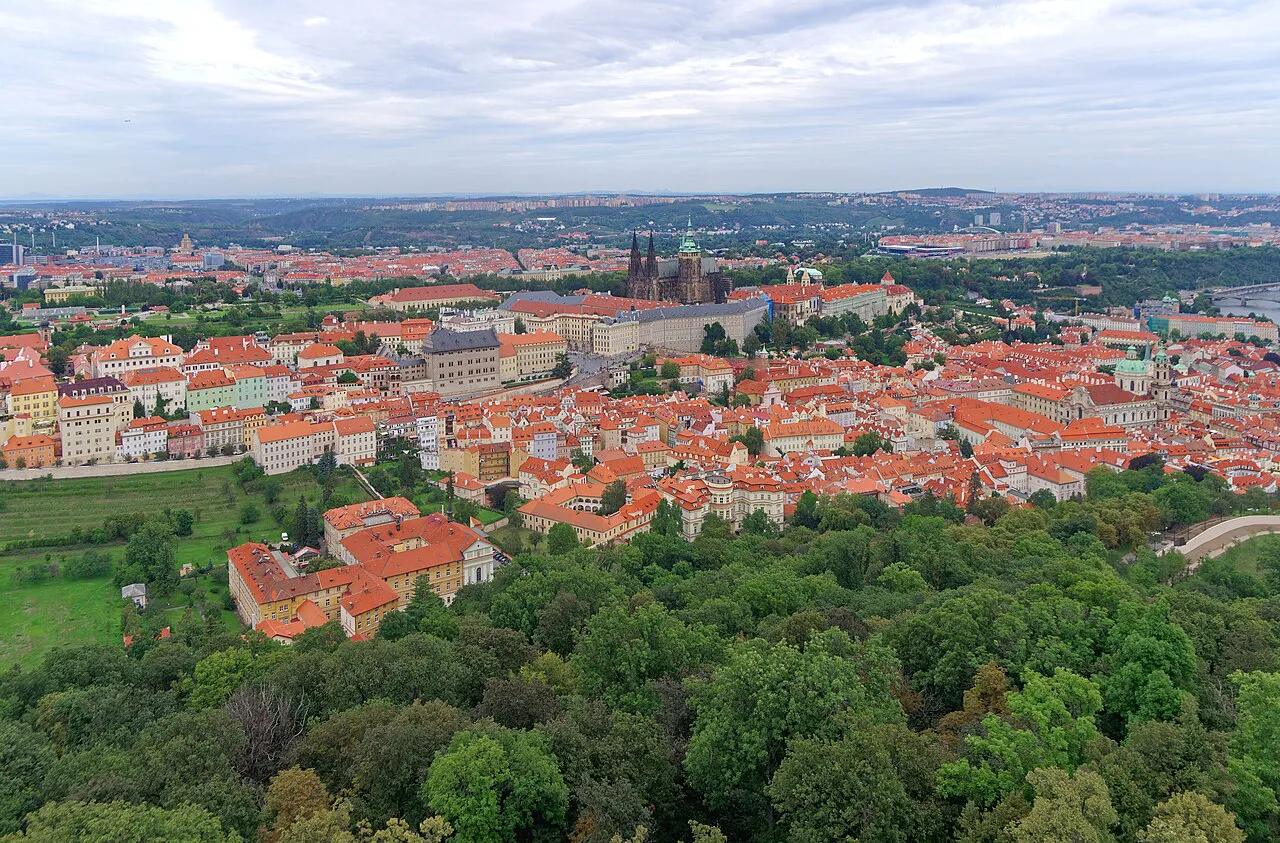
Start with Prague Castle, Český Krumlov and Karlštejn. Prague Castle is recognized as the largest ancient castle complex in the world and has been the seat of Bohemian princes, kings and Czech presidents; the main circuit covers St. Vitus Cathedral, the Old Royal Palace, the Basilica of St. George and Golden Lane with the Daliborka Tower. Adults pay CZK 450, reduced CZK 300, and a family of two adults with up to five children CZK 950, and the ticket stays valid for two consecutive days, a detail few visitors use. Buildings open 9am to 5pm from April to October and 9am to 4pm from November to March.
Can you photograph inside Czech castles? It depends on the circuit. The Chapel of the Holy Cross at Karlštejn is protected for its microclimate and the Baroque Theatre at Český Krumlov holds original machinery, sets and costumes, so photography rules are set per route and are usually posted at the entrance and stated by the guide at the start.
Why are Czech castles visited on guided tours? Most of the headline state-run castles and chateaux show their furnished interiors only on a timed guided tour rather than by self-guided wandering, and tickets are published in koruna. English tours are not guaranteed, so it pays to check whether your circuit runs in English before you book a specific departure.
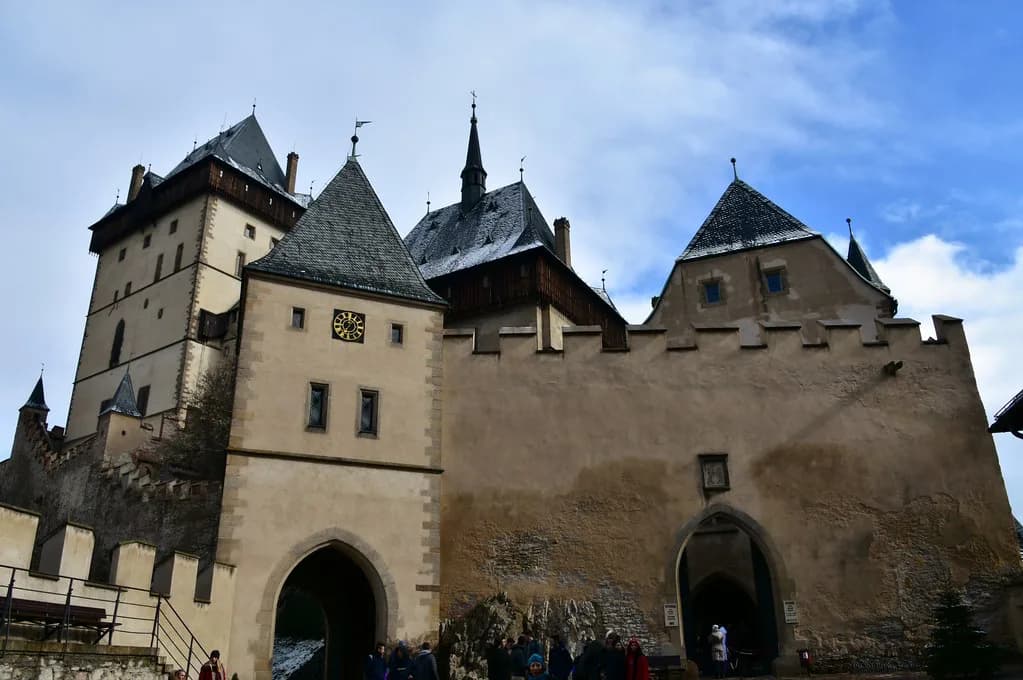
Český Krumlov is the country's second largest castle complex: seven hectares, more than 40 buildings, five courtyards and a painted round tower above a bend in the Vltava about 175 km south of Prague. The town center joined the UNESCO list in 1992, and the castle's routes are ticketed one by one rather than bundled. Karlštejn, the Gothic fortress Charles IV built between 1348 and 1355 some 30 km southwest of Prague, is the easiest half-day from the capital, though it asks more of your legs.
Karlštejn: Route I versus Route II
Karlštejn sells two main circuits and they are not close in price. Route I, the Emperor's Residence, costs CZK 300 for adults, CZK 240 for students and seniors and CZK 90 for children, and it is the sensible pick if you want the story of Charles IV's fortress without committing a large slice of the day. Route II reaches the Chapel of the Holy Cross in the Great Tower, a far more atmospheric space, and costs CZK 640, or CZK 510 reduced and CZK 190 for children aged 6 to 17.
The Chapel circuit must be reserved in advance because capacity is capped to protect the chapel's microclimate, so Route II is a decision you make before you travel, not at the ticket window. Whichever you choose, the walk up from the village takes about 25 minutes and is steep, which turns a comfortable morning into a proper climb in warm weather. Wear shoes for it and leave the castle for the middle of the day rather than squeezing it in before a train.
Český Krumlov Castle: the separately priced routes
At Český Krumlov every circuit carries its own ticket. The Renaissance and Baroque apartments cost CZK 300, the 19th-century apartments CZK 260, the castle museum and tower CZK 280, the stables CZK 80 and the Belvedere pavilion CZK 200, while the castle garden is free. That menu lets you build a cheaper half-day or a full one, and the garden plus tower combination is the low-cost option when the apartments are sold out.
If you buy one interior, make it the Baroque Theatre. At CZK 400 it is among the most completely preserved 18th-century theatres anywhere, with original machinery, sets and costumes, and it opens from 1 April in the 2026 season. Everything about Krumlov is busiest at midday, so book the theatre for the morning and walk the courtyards and garden afterward, when the tour groups have moved on toward their buses.
South Bohemia: Hluboká nad Vltavou
Hluboká nad Vltavou is the white Neo-Gothic chateau the Schwarzenbergs rebuilt between 1840 and 1871 on an English model, 10 km north of České Budějovice. Interiors are guided-tour only and each route is ticketed separately: Representational Rooms CZK 300, Hospitality Rooms CZK 320, Private Apartments CZK 220, Kitchen CZK 180, a self-guided tower CZK 180 and a winter route CZK 200. It closes on Mondays, so pair it with a Tuesday or later in the week if you are working backward from Český Krumlov.
The park is free, and the view back over the Vltava is the photograph everyone takes. Treat the park as the free part of the day and pick one interior circuit according to taste: the representational rooms for state grandeur, the private apartments for family life, the kitchen for the working side of a great house. Two routes in one visit means two departure times, which is usually too much for an afternoon.
South Moravia: Lednice and the Lednice-Valtice landscape
Lednice is the Neo-Gothic centerpiece of the Lednice-Valtice Cultural Landscape, UNESCO-listed since 1996 and often described as the largest man-made landscape in Europe, about an hour south of Brno. Adult admission is CZK 300, with CZK 240 for students and seniors and CZK 90 for children. It opens daily 9am to 5pm from May to August and runs Tuesday to Sunday in September, which makes it a reliable anchor for a South Moravian route built around Mikulov, Valtice and Znojmo.
The appeal here is the setting as much as the rooms: a chateau sitting in designed parkland and water, with Valtice a short hop away as the second half of the same UNESCO property. Book the interior for the shoulder season if you can, when the September weekday pattern still gives you six days a week of opening and far thinner groups.
Monday closures and the winter shutdown
The Monday rule catches people out because it applies to interiors rather than to the town. State castles close on Mondays and shut their interiors for winter, typically reopening at weekends in April and going daily from May, so a Monday arrival means gardens, courtyards and exteriors only. Build itineraries with Monday as a walking day in a UNESCO town or a travel day between bases, and leave castle circuits for Tuesday onward.
Winter changes the offer rather than ending it. Hluboká lists a separate winter route at CZK 200, but the full summer circuits are not the winter offer, and guided commentary may be limited to Czech. April and late October are the sweet spots: interiors open at weekends before the May crowds, and weekday visits in September feel nothing like July at Český Krumlov.
What castle tickets cost in CZK
Budget in koruna and treat these figures as the published scale rather than a quote for your dates. A single adult interior circuit at the castles covered here generally sits between CZK 220 and CZK 400, with Karlštejn's Chapel route at CZK 640 and the Český Krumlov theatre at CZK 400 above that band. Family tickets and reduced rates cut the total sharply if you are traveling with children, students or seniors, and the Prague Castle family ticket at CZK 950 covers two adults and up to five children.
The cost that surprises people is stacking circuits. Three routes at Hluboká in one day can cost more than a night's dinner, and none of them includes the park, which is free. Choose one interior per castle, spend the saved money on a second castle town, and remember that the tower and garden options at Český Krumlov deliver the view for the least money.
Getting to the castles from Prague and Brno
Prague is the practical base for Prague Castle, Karlštejn and Český Krumlov, and Brno for Lednice and the South Moravian chateaux. Karlštejn is close enough for a half-day by train plus the steep walk up from the village, while Český Krumlov sits about 175 km south of Prague and works better as an overnight than a rushed return. Hluboká is 10 km from České Budějovice, which puts it on the same rail corridor as Krumlov.
Check current train and bus times before you commit to a circuit departure, because castle slots and timetable gaps are where day trips fail; the castle ticket offices and the national rail and bus timetables publish what you need. A car buys flexibility on the South Bohemia loop between Hluboká and Krumlov, but parking near the Krumlov center is the constraint, so an early arrival matters more than horsepower.
Beyond the headline names
Once you have seen the big three, the Czech castle map opens up by region. In the Liberec Region, Houska Castle is known for the mystery of its pit and rewards travelers who want legend with their Gothic walls rather than another furnished salon. On the other side of the country, Pernštejn Castle built a reputation as an almost impregnable medieval seat, and it suits a day between Brno and the Vysočina.
Moravia adds more: Bouzov castle in the Olomouc Region, rebuilt under Archduke Eugen of Austria into the romantic image most visitors expect, and Helfštýn Castle above Týn nad Bečvou, where the ruined walls now host ironwork symposia. Bezděz Castle, founded by Přemysl Otakar II, is a royal ruin with a view, and Střekov Castle hangs over the Elbe at Ústí nad Labem.
Ruins and legends are their own genre, and if you like a story with your stonework, the haunted castles Czech Republic are a good second layer after the state interiors. Pair a castle afternoon with a Czech beer stop in a town like Kutná Hora, and you have the shape of a good byway day: one circuit, one walk, one long lunch.
Where to eat near a castle afternoon
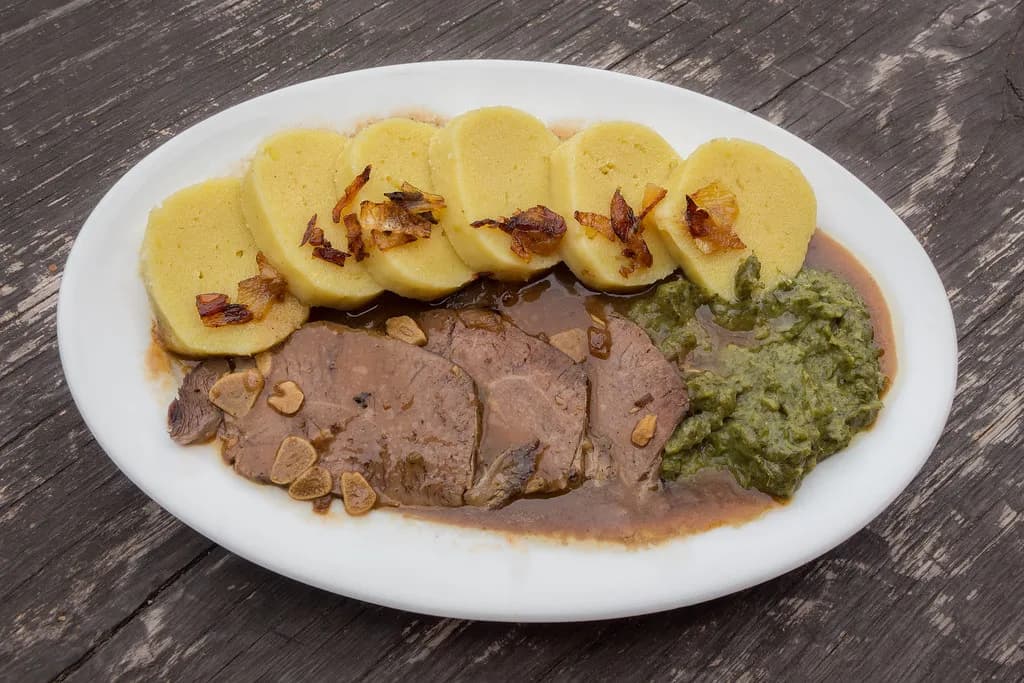
Castle towns do food well and simply, and the pattern is consistent: a lunch of svíčková or goulash with bread dumplings before the tour, coffee and something sweet after. Because circuits run to a schedule, eat before your slot rather than gambling on a table afterward, when the coach groups descend at once. In South Bohemia, look for fried carp or roast pork with dumplings and cabbage, and in Moravia for heartier pork dishes.
Drink local where you can, and if you want to know what to order and what the labels mean, the Czech beer guide covers it. Keep the afternoon light if you have a Route II slot at Karlštejn, because the climb back up after a heavy lunch is not kind.
Which castle circuit should you book first?
Book Karlštejn Route II first if you want one memorable interior, because the Chapel of the Holy Cross needs an advance reservation and capped capacity makes it the hardest ticket on this list. Otherwise pick Prague Castle for its two-day validity and free Golden Lane after closing, then Český Krumlov for the Baroque Theatre and its free garden.
Fit the rest around the calendar rather than the map: nothing on a Monday, weekends in April, daily from May, and September weekdays for South Moravia. One circuit per castle, one castle per day, and the Czech castle country rewards you with the thing tour groups never get, which is time in the courtyard when the buses have gone.
Explore more Czech Republic guides
Frequently Asked Questions
Can you photograph inside Czech castles?
It depends on the circuit. The Chapel of the Holy Cross at Karlštejn is protected for its microclimate and the Baroque Theatre at Český Krumlov holds original machinery, sets and costumes, so photography rules are set per route and are usually posted at the entrance and stated by the guide at the start. Ask before the tour begins rather than midway, and expect restrictions in the most fragile rooms.
Why are Czech castles visited on guided tours?
Most of the headline state-run castles and chateaux show their furnished interiors only on a timed guided tour rather than by self-guided wandering, and tickets are published in koruna. English tours are not guaranteed, so it pays to check whether your circuit runs in English before you book a specific departure.
Sources
Notes for your Czech trip
Optional updates to our Czech town guides.
You might also like
Continue reading
More guides you'll find useful