Velehrad: Moravia's Pilgrimage Basilica and Monastery
Velehrad centers on the Basilica of the Assumption and Saints Cyril and Methodius, the monastery underground, and the Church of the Epiphany.
On this page
Velehrad is worth a half day: a small Moravian pilgrimage village wrapped around an 800-year-old Cistercian monastery, with a basilica, a Romanesque lapidarium in the monastery underground, and a gate church all within a few minutes of each other. The village sits in the Uherské Hradiště District of the Zlín Region and has about 1,100 residents, so the sights are close together and the day is spent looking rather than traveling. This guide sequences the basilica, the underground, and the Velehrad House, flags the interiors that need arranging in advance, and shows how the stop fits a route through South Moravia.
The valley was settled long before the monks arrived: the first twelve Cistercian monks came to the valley of the Salaška stream to build near the village of Veligrad, today Staré Město, under founders including King Přemysl Otakar I, the Moravian margrave Vladislav Jindřich, and Robert, Bishop of Olomouc. Construction of the church probably began between 1210 and 1215, and the monastery took the Assumption of the Virgin Mary as its patron, with Cyril and Methodius added as co-patrons by a decree of Pope Pius XI in 1932.
Why Velehrad matters: Cyril and Methodius and Great Moravia
Velehrad's pull is not architectural alone. The monastery was planted in a landscape already charged with the memory of the ninth-century mission of Constantine and Methodius to Great Moravia, and the site became the bearer of that older tradition rather than simply a Cistercian house. That layered history is why the village carries a symbolic weight across Europe, not just a regional one.
Pope John Paul II declared Cyril and Methodius common patrons of Europe in 1980, and Velehrad was the first place he visited after the fall of communism in 1990. The pilgrimage tradition runs deeper still: thousands of pilgrims have come for centuries, and the site's twentieth-century history includes unionist congresses and a national pilgrimage in 1985 that became a rallying point for religious freedom. Read those dates as history, and let them frame what you are looking at inside the basilica.
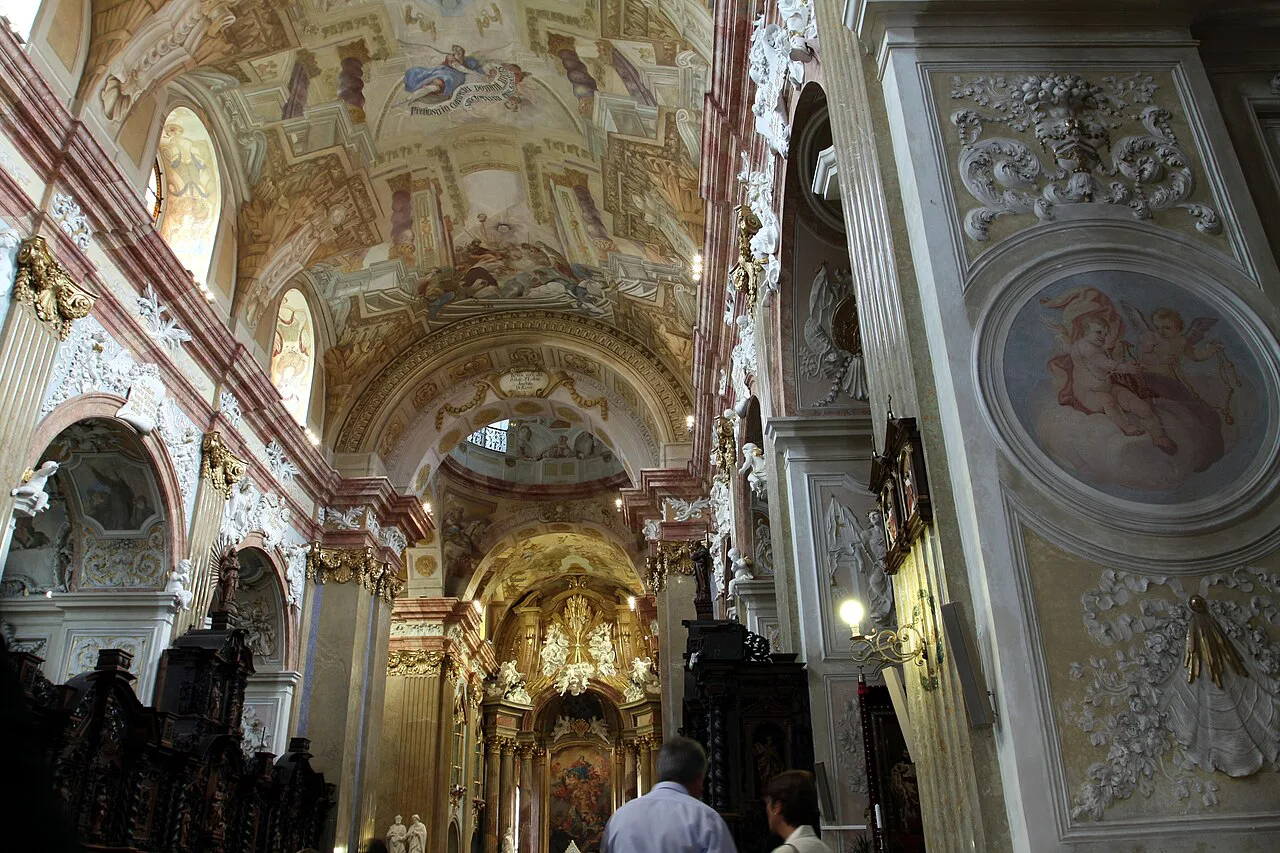
The Basilica of the Assumption of the Virgin Mary and Saints Cyril and Methodius
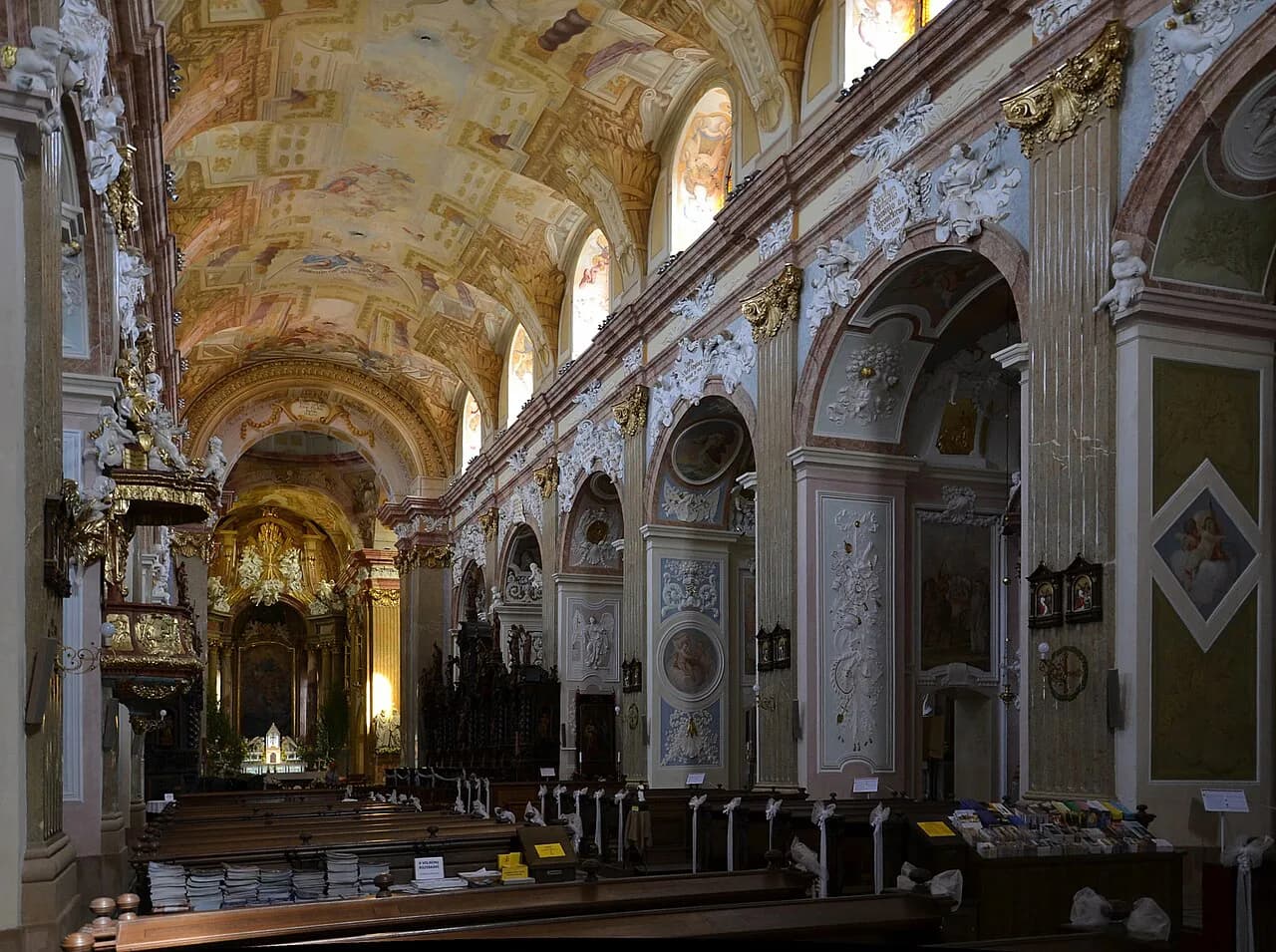
The basilica is the center of any visit, and four things inside reward a slow walk. The high altar anchors the church; the Chapel of Our Lady Mother of Christian Unity holds the palladium of Velehrad, the devotional object most associated with the site; the Royal Chapel contains the tomb of Archbishop A. C. Stojan; and the presbytery holds the mosaic-decorated sarcophagus of Cardinal Tomáš Špidlík SJ. Knowing these four before you enter turns a quick look into a proper visit.
Both Stojan and Špidlík are buried in the basilica, which is unusual enough to be worth pointing out to anyone traveling with you who expects a standard parish church. The interior is also an active worship space rather than a museum room, so services can interrupt sightseeing and should shape when you arrive; an early start fits better than arriving mid-morning on a pilgrimage weekend.
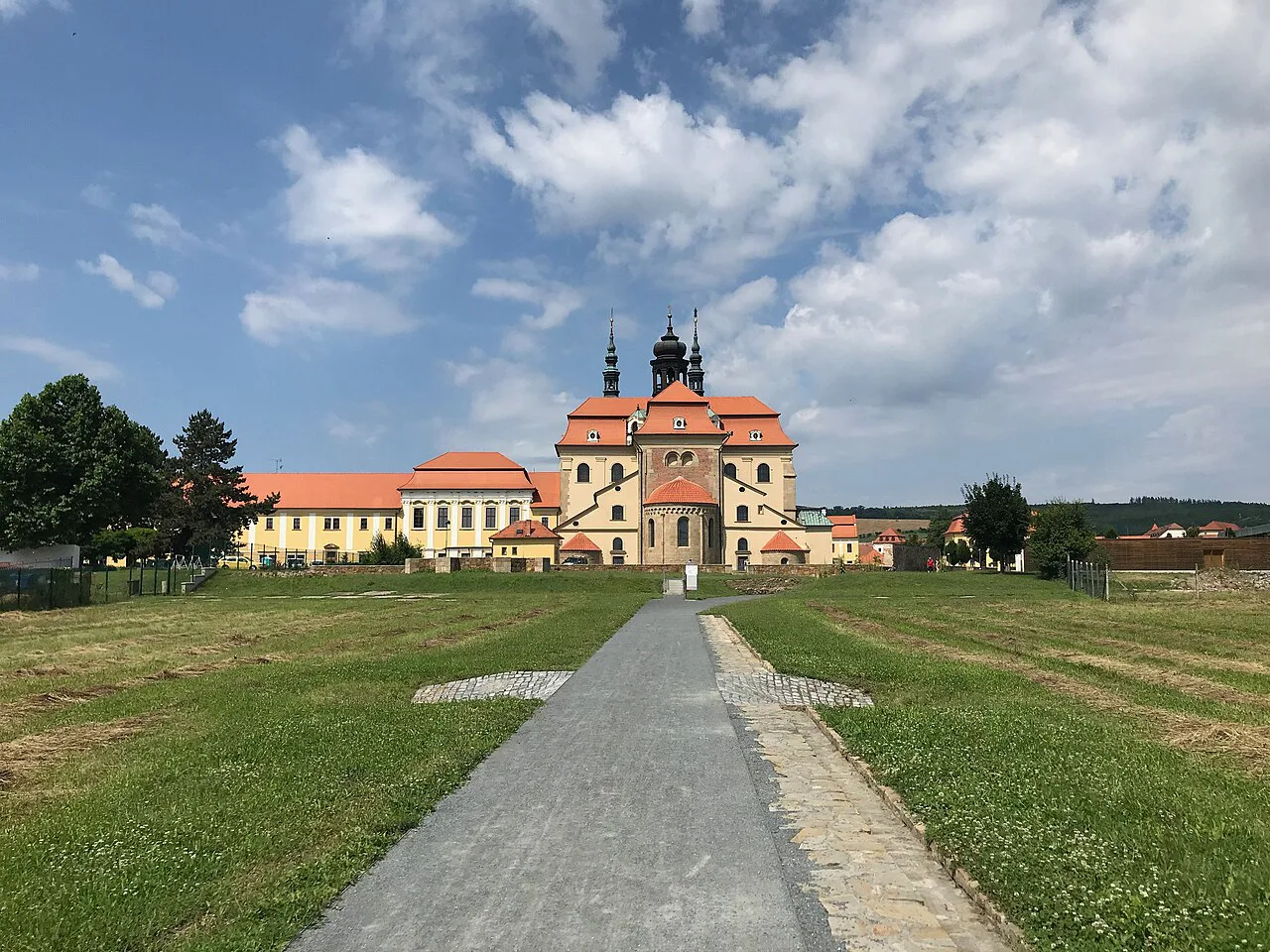
The monastery underground: lapidarium, chapter hall, and the Golden Rose
Below the church, a complex of corridors holds a lapidarium of building monuments from the original Romanesque monastery, and the accessible route includes the ambit, the chapter hall, and the Baroque crypt. This is the part of Velehrad that most rewards a ticket: carved stone from the earliest phase of the monastery, displayed where the building actually stood.
The same underground also houses Martyrion, an exhibition on twentieth-century Christian martyrs, and the Golden Rose that Pope John Paul II dedicated to Velehrad. Pair the lapidarium with Martyrion rather than treating them as separate stops, since they share the same corridor system and set the medieval monastery against modern persecution in a way that is hard to get elsewhere.
The Church of the Epiphany, or Cyrilka
Just outside the main complex stands the Church of the Epiphany, known locally as Cyrilka, built in the thirteenth century at the monastery gate for the pre-monastery inhabitants. It fell into disrepair in the nineteenth century and was restored in neo-Gothic style for the 1863 jubilee of Cyril and Methodius. In the first half of the twentieth century, services here were celebrated in the Byzantine-Slavic rite.
Cyrilka is small and easy to miss if you walk straight to the basilica, so make it the first or last stop and give it ten or fifteen minutes. Its position at the old gate explains the whole layout of the village: the monastery was the core, and everything else grew around its entrance.
The Velehrad House of Saints Cyril and Methodius
The Velehrad House occupies former farm buildings of the monastery, the granary and stables, renovated between 2010 and 2011, and sits at a major crossroads in the village. It is the practical hub: an information center, museum exhibitions, a lecture hall, a confectionery, a pilgrimage shop, and accommodation. Start or end here, because it is where you arrange the parts of the visit that are not simply open to walk into.
Two exhibitions sit inside the house: Velehrad at the crossroads of European history, which is the one to see if you want the site's story explained in sequence, and Bible for young and old. The house also has a confectionery and a pilgrimage shop, so you can pick up something sweet or a souvenir on site rather than counting on a full restaurant row in the village.
Sala Terrena and the Slavic Hall in the former monastery
The former monastery buildings, now home to the Stojan Gymnasium, contain the Baroque Sala Terrena and the Slavic Hall, and these are the interiors that catch people out. They are not simply open to walk into; a tour is arranged through the information center, so ask when you arrive rather than assuming you can join a group at the door. Putting that request in at your first stop is the single most useful planning step at Velehrad.
Treat this as the flexible part of the day. If a tour can be arranged, it adds the monastery's grand secular rooms to the ecclesiastical sights; if not, the basilica, underground, Cyrilka, and the house exhibitions already fill a solid half day. The information center also arranges guided tours of the basilica, which is the other service worth asking about on the same stop.
The ambit and Otmar Oliva's sculpture exhibition
The ambit closes the pilgrimage courtyard on its north side, and along it stand eight Baroque statues of St. Benedict, St. John the Baptist, St. Peter, St. Cyril, St. Methodius, St. Paul, St. John the Evangelist, and St. Bernard. It is a covered walk rather than a sight with a ticket, which makes it the natural place to slow down between the church and the house.
On the ground floor of the tourist center, the permanent exhibition The Story of a Sculpture presents work by the academic sculptor Otmar Oliva, tracing nearly forty years of an oeuvre shaped by political imprisonment and Christian belief. It is a compact, modern counterweight to the Baroque and Romanesque elsewhere, and it suits anyone who wants contemporary art alongside the pilgrimage history.
How long Velehrad takes and how to sequence it
A sensible order is information center first to ask about the Sala Terrena and Slavic Hall tours, then the basilica, the underground with the lapidarium and Martyrion, Cyrilka at the gate, and the Oliva exhibition and ambit to finish. That keeps the two arranged-access elements at the front and back of the visit. A half day covers it comfortably; a full day only makes sense if you add stops nearby.
Watch the calendar rather than the clock. Velehrad is an active pilgrimage site, and worship in the basilica can restrict sightseeing, while major pilgrimage days fill the courtyard and the village lanes. If your schedule is flexible, aim for an ordinary weekday and treat any major feast as a reason to arrive early rather than to skip the stop.
Getting to Velehrad and pairing it with Buchlov and Buchlovice
Velehrad sits in the Uherské Hradiště District of the Zlín Region, in the valley of the Salaška stream near Staré Město, which puts it in the eastern part of the South Moravia circuit rather than on the Mikulov–Lednice axis. Coming by car is the straightforward way to combine it with other stops; Uherské Hradiště or the surrounding villages make a practical base for a wider loop.
The natural next stop is Buchlov castle and Buchlovice chateau nearby, which turns a pilgrimage visit into a full day of church and country-house sightseeing. Treat them as separate visits with their own arrangements rather than assuming a single ticket covers all three. If your route runs west instead, the Lednice–Valtice Cultural Landscape makes a UNESCO World Heritage Site counterpoint to Velehrad's religious history.
Book the arranged interiors first
The visit hinges on one decision: whether you want the Sala Terrena and Slavic Hall, which are seen only by arrangement through the information center. If you do, ask the center before you travel and plan the rest of the day around that slot; if you do not, the basilica, the underground, Cyrilka, the ambit, and the exhibitions make a complete half day on their own.
Then decide the shape of the day around it: Velehrad alone, or Velehrad with Buchlov and Buchlovice for a fuller loop through this corner of the Zlín Region. Either way, treat the basilica as a working church first and a monument second, and the visit will go more smoothly.
Explore more Mikulov guides
- Dolní Věstonice
- Kroměříž
- Lednice-Valtice Cultural Landscape
- Mikulov Castle
- Mikulov: A South Moravian Town Guide Beyond Prague
- Podyjí National Park
- Pálava: The Limestone Hills Above Mikulov, Explained for Visitors
- Valtice
- Vranov nad Dyjí Chateau
- Znojmo Underground
- Znojmo: A South Moravian Town Guide Beyond the Square
- Lednice Minaret
- Lysice Chateau
- Mikulov Attractions
Frequently Asked Questions
Do you need tickets for Velehrad?
The monastery underground is a ticketed part of the site: its circuit includes the lapidarium of Romanesque building monuments, the chapter hall, the Baroque crypt, and the Martyrion exhibition on twentieth-century Christian martyrs, and the Velehrad House holds museum exhibitions of its own. The basilica and the covered ambit are visited as church and courtyard space rather than as a ticketed circuit. The information center in the Velehrad House is the place to confirm current opening and any admission charge when you arrive.
Are there English-language tours at Velehrad?
The information center arranges guided tours, including tours of the basilica and access to the Baroque Sala Terrena and Slavic Hall in the former monastery buildings. Ask about the language of any tour when you make contact rather than assuming an English departure will be running on your date.
Can you visit Velehrad on a day trip from Brno?
Velehrad lies in the Uherské Hradiště District of the Zlín Region, east of Brno, and works as a day trip by car, especially when paired with Buchlov castle and Buchlovice chateau nearby. If you plan to come by rail or bus, check current timetables for your date before fixing the plan.
Sources
Notes for your Czech trip
Optional updates to our Czech town guides.
You might also like
Continue reading
More guides you'll find useful