
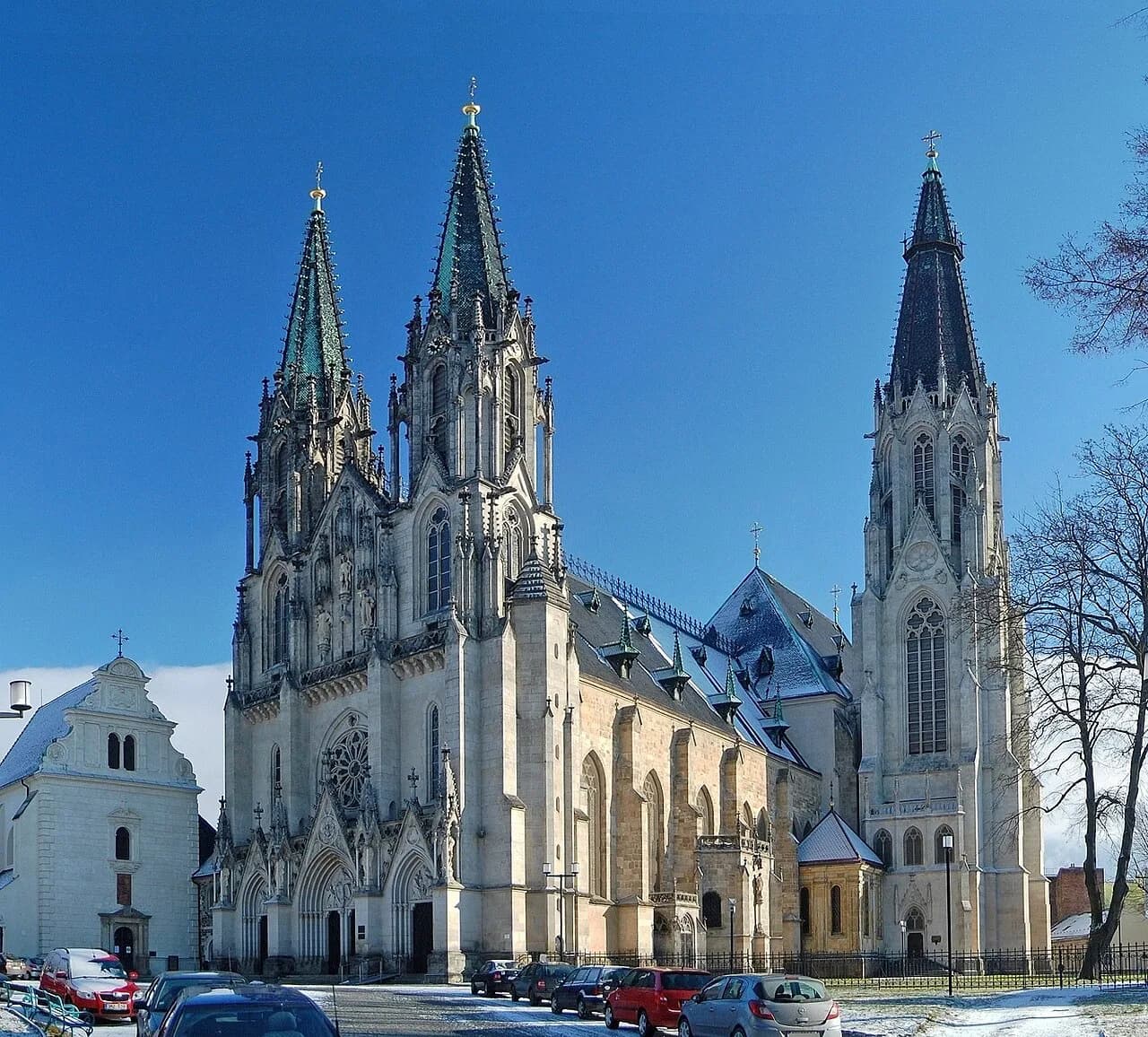
St. Wenceslas Cathedral in Olomouc: What to See and How Long to Allow

St. Wenceslas Cathedral is the one sight in Olomouc that rewards a dedicated stop rather than a glance, and an hour on Dom Hillock covers it well if you add the Romanesque palace next door. The building compresses nine centuries into a single outline, and knowing which parts are Romanesque, which are Baroque and which were rebuilt in the 1890s is what turns a quick look into a real visit. This guide fixes the cathedral on the map, walks you in from the Upper Square, and flags the details worth hunting down inside.
What St. Wenceslas Cathedral is and why it anchors Dom Hillock
Construction began before 1107 under Prince Svatopluk, and the church was consecrated in 1131 while still unfinished under Bishop Jindřich Zdík. Fires in 1204 and 1265 destroyed much of the early fabric, and each rebuilding pushed the church toward the taller, vaulted Gothic structure you see today. That long accretion is why the cathedral reads as a history lesson in stone rather than a single-period monument.
The cathedral sits at the heart of Dómské návrší, the cathedral hillock that local tourism material treats as the logical starting point for a walk through the historic center. Wenceslas Square in front of the facade gives you the long view of the southern tower, and the square doubles as the natural gathering point before you head into the old town. Come here first, then work downhill toward the squares.
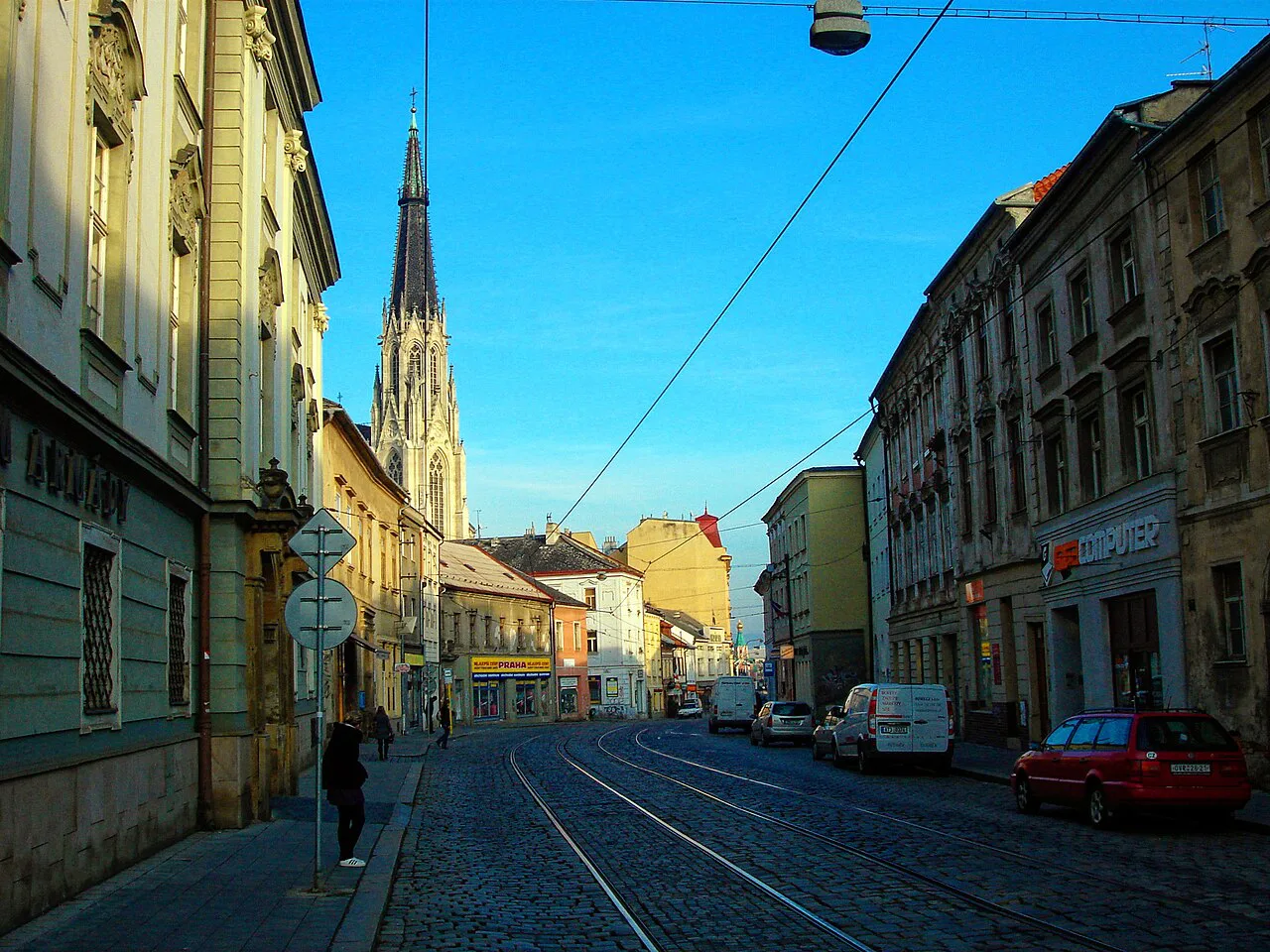

Where it is: Wenceslas Square on the cathedral hillock
The address is Václavské náměstí in Olomouc 9, the postcode district covering the historic core. The cathedral faces the square across a paved forecourt, with the bishop's residence and chapter buildings clustered around it. If you are navigating by map, search for the Czech name Katedrála svatého Václava rather than the English translation, which appears inconsistently in mapping apps.
Orientation is simple once you are on the hillock: the cathedral's high southern tower is visible over the rooftops from much of the old town, so you can steer by it. Approach from the north or west and you arrive at the square; approach from the south and you climb toward it. Either way, the building itself is the landmark.
How to reach it on foot from the Upper Square
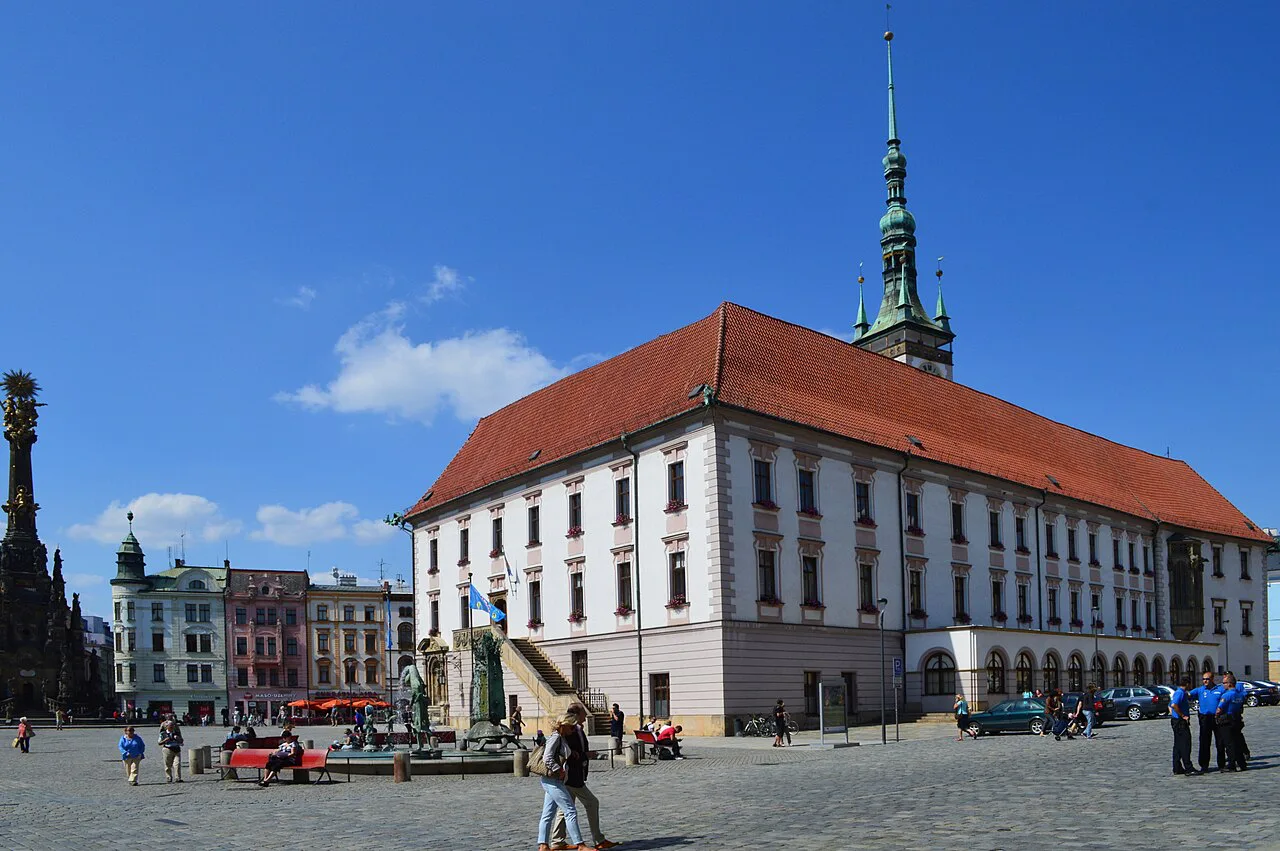
From Horní náměstí, the Upper Square with the Holy Trinity Column and the astronomical clock, the walk to the cathedral takes only a few minutes uphill through the old streets. Head for the cathedral's tower on the skyline and you will find the square without a detailed route. Flat shoes are sensible, since the streets are cobbled and the climb is steady rather than steep.
Olomouc is compact enough that the cathedral works into any walking loop of the center, and you can pair it with the Upper Square sights before or after without retracing much ground. If you are arriving by train, the station sits east of the historic core and the cathedral is a straightforward walk west through town. Leave the car behind; the old center is a pedestrian place.

What to see inside: the neo-Gothic form, the southern tower and the altar
The cathedral's present silhouette is largely a historicist rebuild carried out between 1883 and 1892 under Archbishop Friedrich von Fürstenberg, with architects Gustav Meretta and Richard Völkel reshaping the facade after French models. That campaign gave the church its tall southern tower, its matching choir chapel, and the Latin-cross layout that now defines the interior. Look up: the neo-Gothic vaulting and windows are the work of that era, not the Middle Ages.
The neo-Gothic altar holds a reliquary with the relics of St. John Sarkander, the Moravian priest whose story is bound up with the cathedral's Counter-Reformation history. Earlier layers survive in the fabric too, including the Romanesque twin towers at the west end, now hidden beneath neo-Gothic cladding, and the original three-nave ground plan. The result is a building that lets you read Romanesque, Baroque and 19th-century work in a single sweep of the eye.
The crypt beneath the chancel
Beneath the chancel lies a crypt consisting of two floors, with the lower level holding the coffins of Olomouc's bishops. The original Romanesque crypt under the first apse is not accessible. The bishops' crypt is the part of the visit most travelers miss, and it gives the building a solemn weight that the bright nave alone does not convey. Step down if the crypt is open when you arrive, since access can be limited during services.
The cathedral also carries a dark royal footnote: Wenceslas III, the last Přemyslid king of Bohemia, was murdered in the building on August 4, 1306, likely on the spot near today's Baroque balcony on the north side. It is the kind of detail that makes the nave worth a slow circuit rather than a photo stop. Whether the crypt or other spaces are open on your date is posted on site; ask before you plan around it.
Zdík's Palace and the Romanesque reliefs next door
North of the cathedral stands Zdík's Palace, the Romanesque bishop's and chapter house built in the 1140s under Jindřich Zdík, whose pilgrimage to the Holy Land shaped the project. Its carved window reliefs are among the finest Romanesque sculpture in Central Europe, and the restored building still shows the high level of Romanesque art in Moravia. Treat it as the second half of your cathedral visit, not an optional extra.
The Archdiocesan museum Olomouc is another sight on the hillock, and its collections give context to the cathedral's art and history if you want to extend the stop indoors. Between the cathedral, Zdík's Palace and the museum you can easily fill a morning without leaving the hillock.
How long to allow and when the cathedral is quiet
Budget about an hour for the cathedral and Zdík's Palace together, or allow two if you add the Archdiocesan museum. The church interior itself asks for twenty to thirty minutes unless you linger over the altarpiece and side chapels. Come in the morning if you want the nave emptier, since the building is an active parish church and service times structure the day.
One honest trade-off: the cathedral is a working church, so you should expect parts of the interior to be roped off or quiet requested during Mass. A visitor-hours listing for the building shows it open daily from morning to early evening; because those hours cover the parish's daily use as well, an early arrival is more reliable than a late one.
Where to check hours, tours and any entry rules
The cathedral's own website is katedralaolomouc.cz, and the parish office phone number is listed alongside its address details. Check that site before you walk up the hill, since the building is a working church rather than a museum with fixed tourist hours. The parish office is the right contact for queries about the crypt and services.
On tours, the cathedral is described as offering guided visits, but the languages, times and any fee are arranged through the parish rather than fixed by a published schedule. If a guided tour matters to you, contact the cathedral directly before your trip rather than assuming one will run during your visit.
Is the cathedral worth the walk up the hill?
Yes, and it makes sense only as part of a circuit: climb to the cathedral and Zdík's Palace first, then work back down to the Upper Square. The cathedral gives you the oldest fabric and the royal murder story, while the Upper Square sights handle the civic set pieces. That order saves you a second uphill climb and keeps the walk downhill for the rest of the day.
If you have time left on the hill, the Olomouc town hall and its astronomical clock reward a look after you descend, and the green edge of town around Bezručovy Sady in Olomouc makes a calm finish to the afternoon. Plan the cathedral for the morning of your Olomouc day and let the rest of the town unfold below it.