
Klášterní Hradisko: Olomouc's Baroque Monastery Complex
Klášterní Hradisko is a national cultural monument on the northern edge of Olomouc, ranked by the operator as the most significant cultural monument of the Olomoucka after the historic center itself. Plan on an exterior and grounds visit of roughly half an hour to an hour, built around the prelature facade, the moat and the adjoining Prelátská zahrada garden. This guide covers where the complex sits, how to reach Sušilovo náměstí, what the building plan tells you, and which artworks are inside the walls.
What Klášterní Hradisko is and who uses the complex today
Klášterní Hradisko is a former Premonstratensian monastery, also written Hradiště in older texts, standing outside Olomouc's central conservation area. Its operator describes it as the most significant cultural monument of the Olomoucka after the town's historic center.
The complex has a long institutional history rather than a single founding date, and it has passed through more than one use since the Premonstratensians. Treat it as a monument in working institutional hands, not as a sight with a ticket desk and a posted opening season. If a gate is shut when you arrive, you are still seeing the intended experience: the architecture from outside and the garden.

Where it sits in Olomouc and how to reach Sušilovo náměstí
The monastery occupies Sušilovo náměstí in the northern part of Olomouc, beyond the old town and the string of parks that ring it. That placement makes it a natural extension of a walk north from the center rather than a separate excursion, and it keeps the crowds down.
Olomouc is compact and flat, so the usual approach is on foot or by the city's trams and buses, with the exact stop best confirmed against a current transport map on arrival. If you are coming from Prague or Vienna, book the train to Olomouc first and treat the monastery as a short add-on to your day in town. City timetables and ticket machines handle the local leg.
The Olomouc information center on Horní náměstí, in the town hall building, is the place to ask about the monastery as well as city tours and the tourist card. Its staff work from the same official listing you are reading here, so bring a map and ask them to mark the approach.
The layout: convent wing, prelature, corner towers and moat
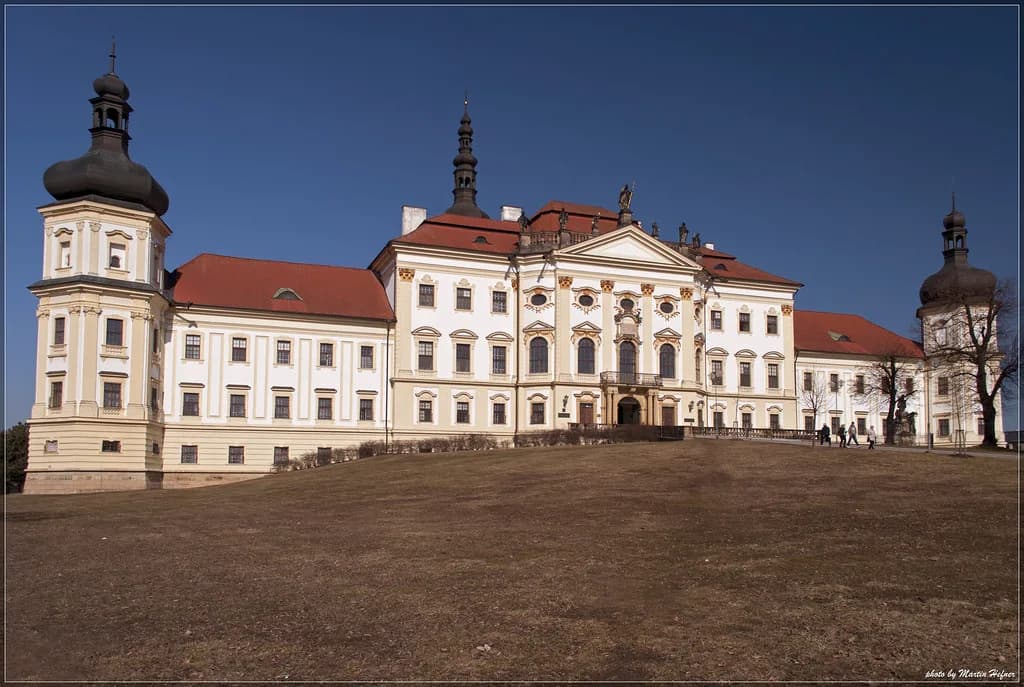
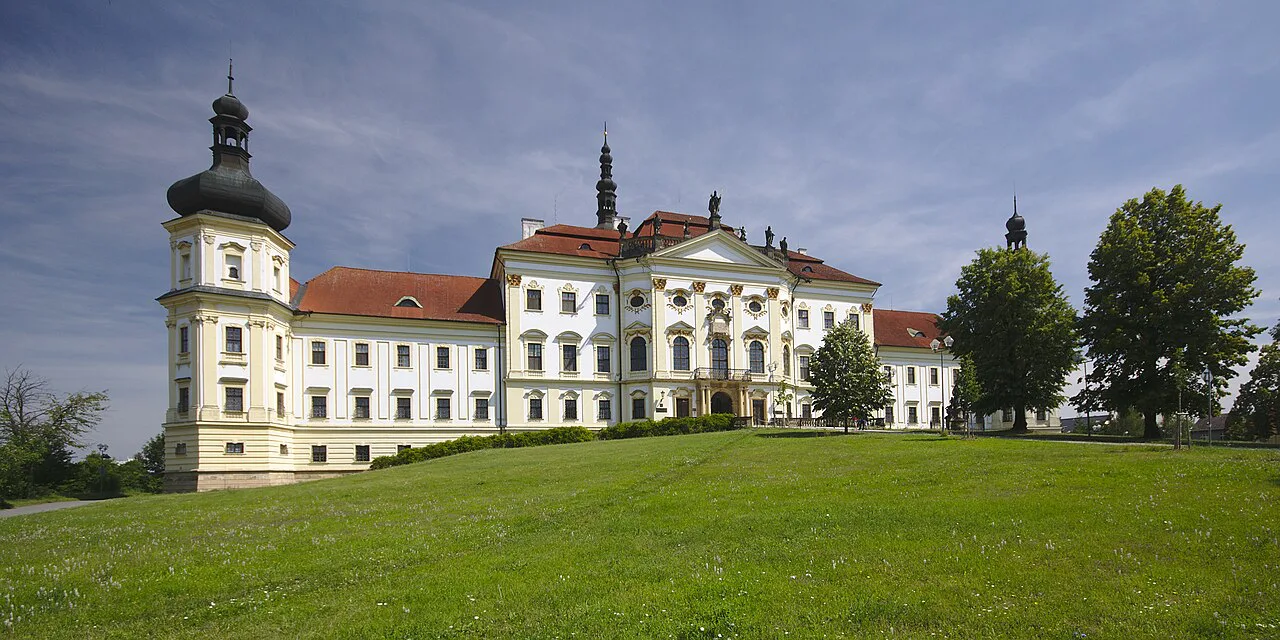
The plan is a rectangle with four wings, corner towers and a moat, split by an internal cross wing into a convent half and a prelature half. Because of that severe, grid-like footprint, Czech writers have nicknamed the complex the Haná Escorial. Knowing this before you arrive changes what you look for: not a picturesque cluster of roofs, but a single long front with a defensive edge.
The northern, convent part was built in a late Italian Mannerist spirit, while the prelature is full-blown high baroque. Walk the outside of the site once with that split in mind and the two halves read differently: flatter and more restrained on one side, taller and more sculptural on the other.
The prelature facade, Paul Troger's ceiling fresco and the library vault decoration
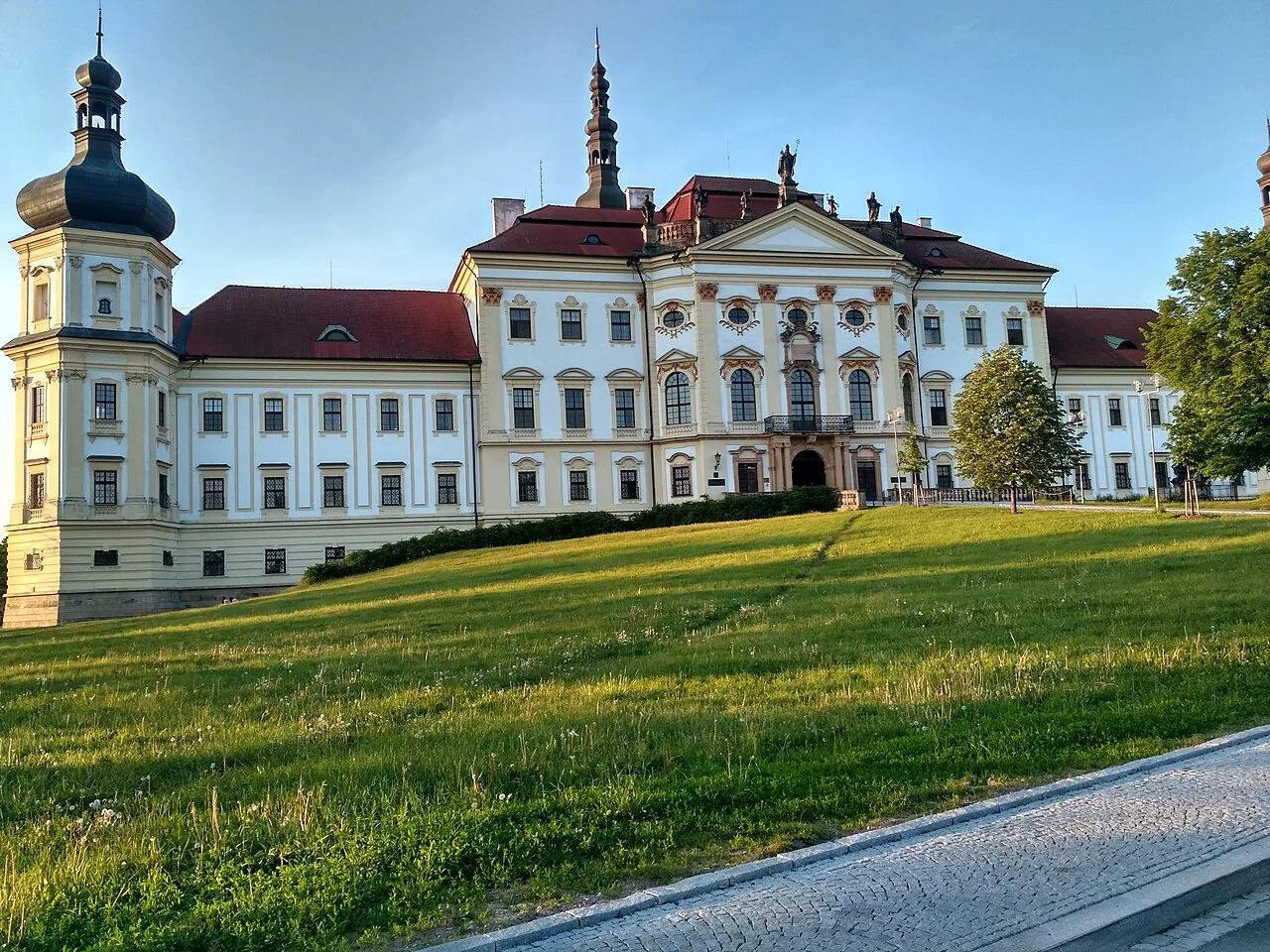
The prelature's monumental front carries sculptural architectural decoration and a portal with columns and a balcony. That portal is the detail to find when you face the main frontage, and it marks the ceremonial entry to the prelature half of the building.
Inside, the ceremonial hall on the prelature's upper floor holds a ceiling fresco painted in 1731 by the Austrian painter Paul Troger on the theme of the miraculous feeding, framed by illusionistic architecture by Antonio Tassi. The monastery library vault carries equally important stucco and painted decoration from the early 18th century, the work of the painter Innocenzo Monti and the sculptor Baltassare Fontana. These are the reasons the complex matters art-historically, and they are also the parts you should not assume you will see.
Do not count on entering these rooms. The frescoes and the library decoration belong to an institutionally used building, and nothing in the city's visitor listing offers them as a ticketed tour. Treat the descriptions as a way of reading the building from the square, and ask at the information center if anything is open while you are in town.
The Prelátská zahrada garden next to the monastery and its two fountains
Beside the monastery lies the Prelátská zahrada, a garden laid out for walking and resting, its present form based on its original baroque design. Flowering shrubs and trees fill it, along with two fountains. This is the practical stop on the visit and the reason to bring a little time rather than just a camera.
Because the garden is a public-style space rather than a walled exhibit, it pairs well with the monastery exterior: see the facade, cross to the garden, sit by a fountain. Keep the pace slow, since there is no circuit to complete and no sequence of rooms to follow.
How much time to allow and what you can realistically see from outside
Budget 30 to 60 minutes for the exterior and garden. That is enough to walk the frontage, find the prelature portal, take in the moat and corner towers, and spend a few minutes in the Prelátská zahrada. Anyone hoping for a two-hour interior tour should plan a different stop.
The honest trade-off is this: Klášterní Hradisko rewards a reader who knows what is behind the wall, not a visitor looking for exhibits and labels. Bring the names Troger, Tassi, Monti and Fontana with you and the blank baroque front becomes legible. If you want guaranteed interiors and opening hours, spend that time in Olomouc's cathedral or the Archdiocesan Museum instead and add the monastery as a walk.

Nearby Olomouc sights to pair with a visit
The obvious pairing is the historic center south of the monastery, where the Holy Trinity Column, a UNESCO World Heritage monument, stands on Horní náměstí. Walk from the monastery into the old town and you pass from an institutional edge into the compact square-and-church core.
On the same square, the Olomouc astronomical clock is one of the few of its kind in Central Europe and sits in the town hall facade. The city's parks, including Bezručovy Sady, make a green route between the center and the northern quarter.
Should Klášterní Hradisko be on your Olomouc list?
Yes, if you like baroque architecture and want a quiet hour away from the main square; no, if you need interiors, labels and a set schedule. Pair the monastery walk with the old town for a balanced day.
Explore more Olomouc guides
Frequently Asked Questions
Can you go inside Klášterní Hradisko?
The complex is an institutional building, and the city's visitor listing does not present the interior as a standard ticketed tour. Plan on the exterior and the Prelátská zahrada garden, and ask at the Olomouc information center whether anything is open during your stay.
Why is Klášterní Hradisko called the Haná Escorial?
The nickname comes from the footprint: a rectangle with four wings, corner towers and a moat, which recalls the severe grid plan of the Spanish royal monastery. It is a useful way to read the building from outside rather than a formal name.