
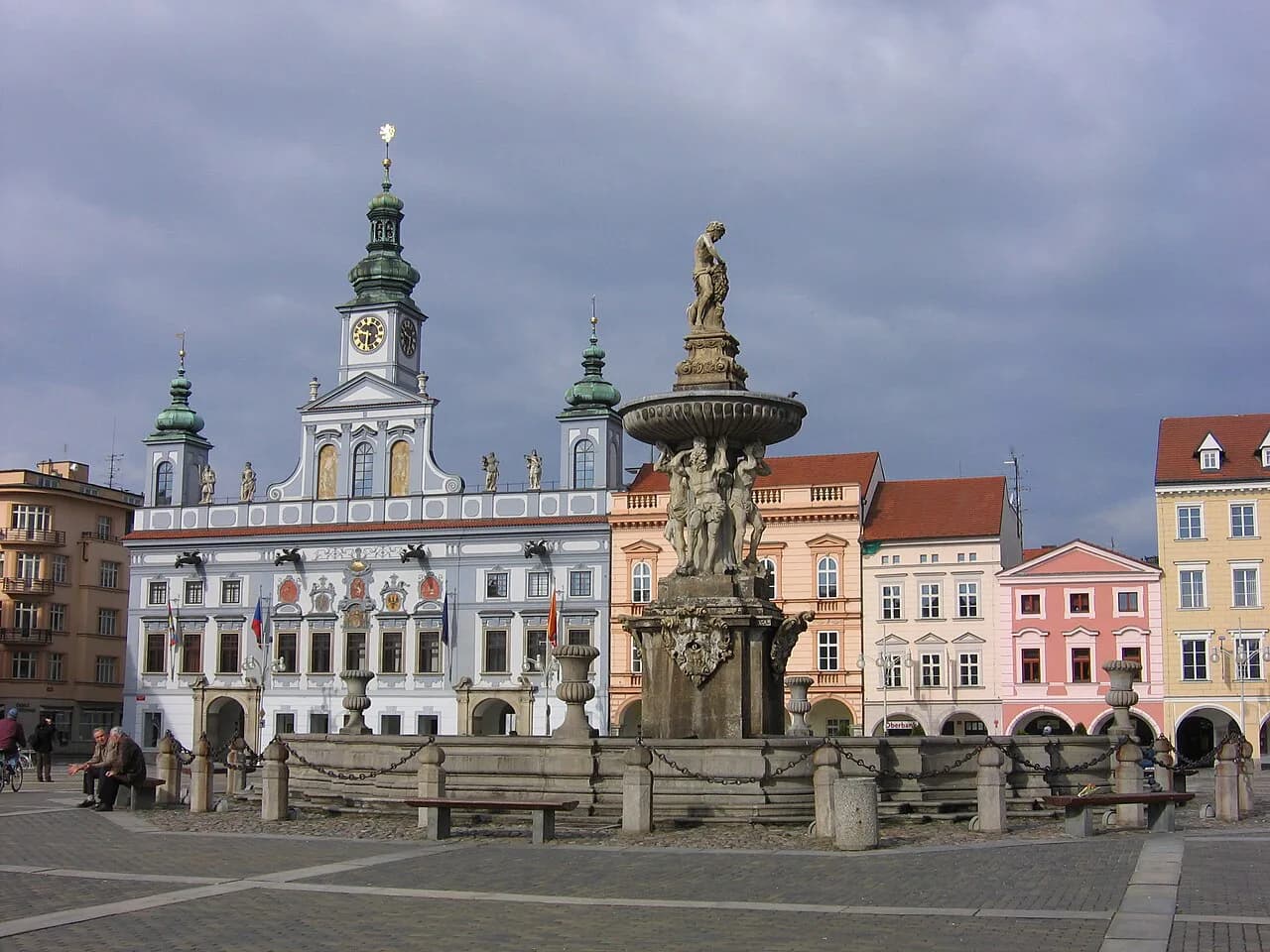
Samson Fountain (Samsonova kašna), České Budějovice

The Samson Fountain is a free, open-air sight on Přemysl Otakar II Square in České Budějovice, and it needs no more than ten or fifteen minutes of your walk through the old center. It is the square's fixed landmark, a stone basin holding the biblical Samson wrestling a lion, and everything else worth seeing in the historic core sits within a few minutes of it. This guide covers what the fountain is, how it fits the layout of the square, what to look at around it, and which nearby sights justify the rest of your time.
What the Samson Fountain is
The Samson Fountain is a stone water reservoir set into the pavement of Přemysl Otakar II Square, the city's main square in the South Bohemian Region. The city's official tourist portal describes it as the largest fountain in the Czech Republic, established as part of the municipal water system in the first half of the 18th century.
Its name comes from the figure on top: Samson fighting the lion, the biblical scene that gives the fountain its identity. The fountain is not a museum piece behind glass or a ticketed attraction, so you can look at it at any hour you happen to cross the square. Treat it as the anchor of a walk rather than a destination in itself.

Where it stands on the square
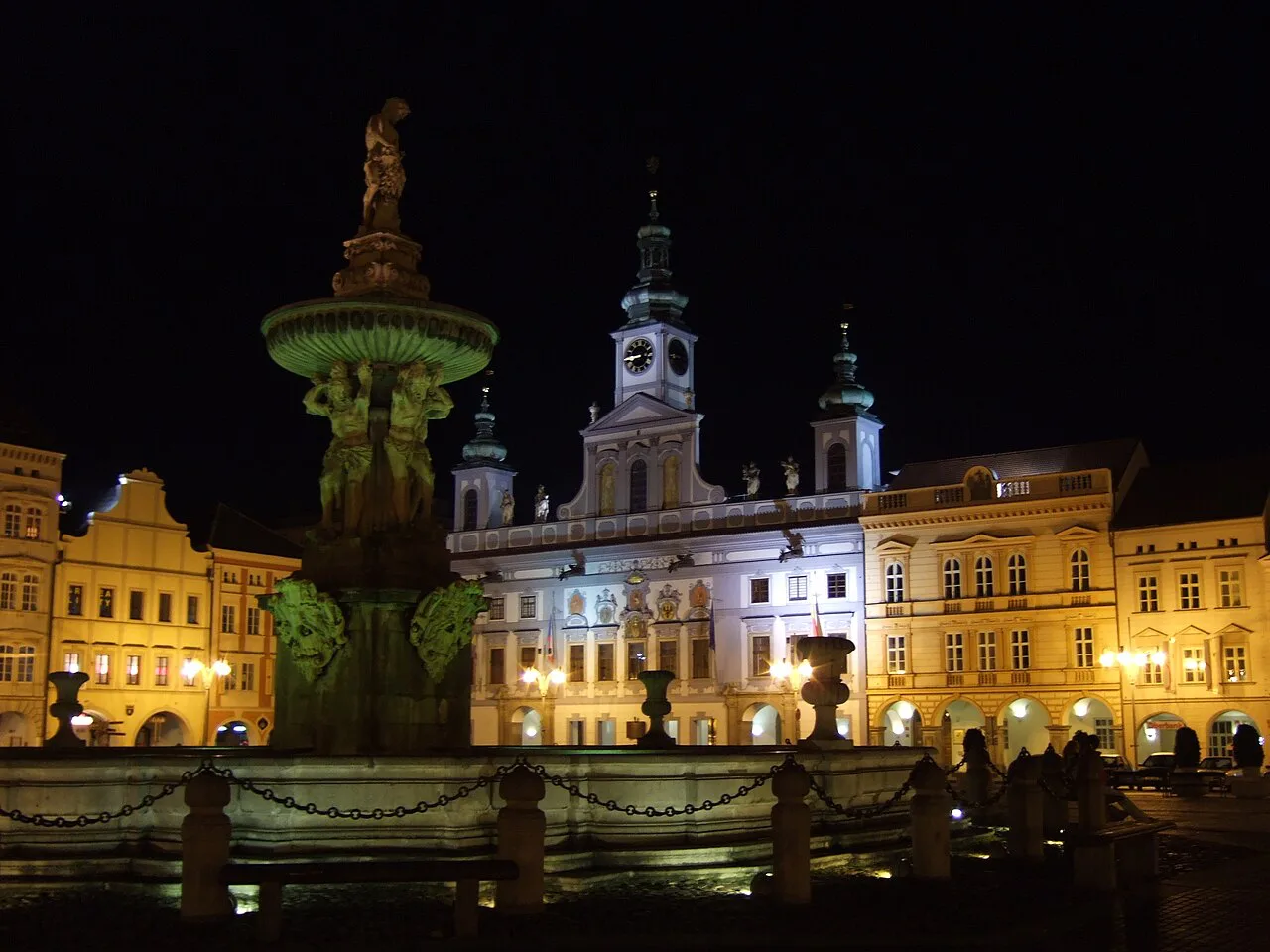
The fountain sits on Přemysl Otakar II Square, a nearly regular rectangle measuring 133 by 137 meters, which the city counts among the largest squares in the Czech Republic. That scale matters: the fountain is small against the square, and you will spot it from the arcades long before you reach it.
It stands near the Lost Rock, the stone set in the pavement by the Samson Fountain on the side toward the Hotel Zvon. That stone marks the spot the city associates with the execution site, and it is one of the square-level details easy to miss if you keep your eyes on the fountain. Approach from the town hall arcade and you will pass both in a single sweep.

The water system behind the fountain
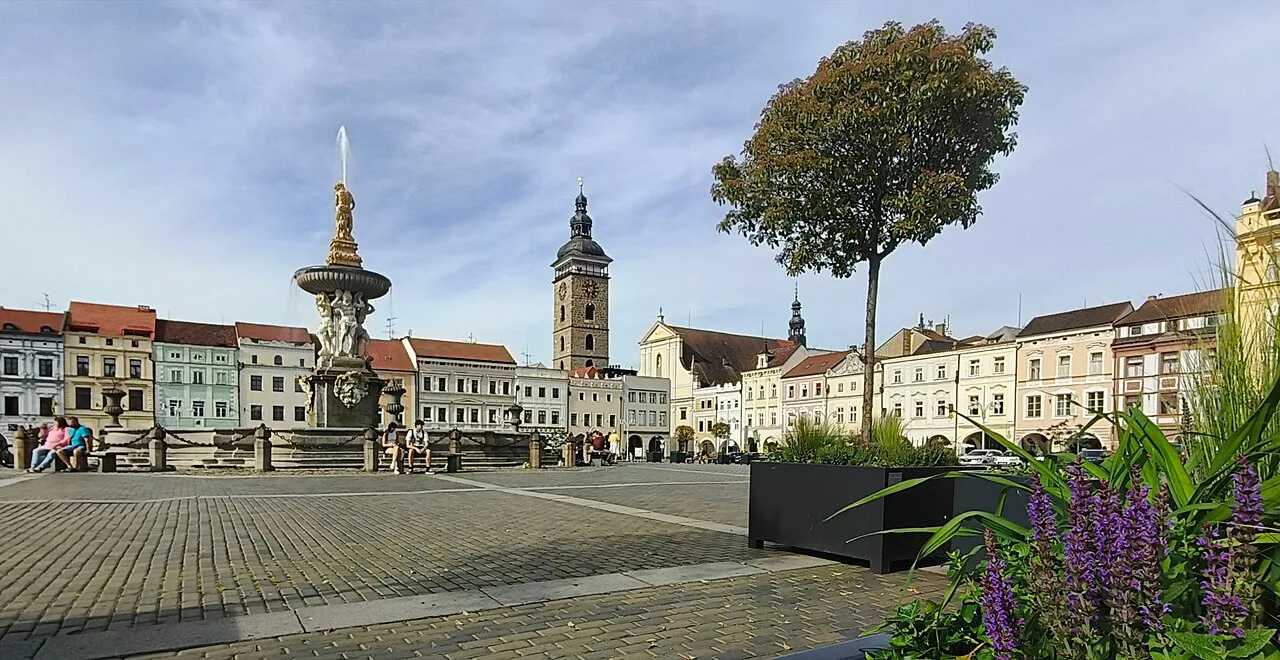
The basin is a working piece of civic infrastructure, not just ornament. According to the city, the stone reservoir holds up to 237 cubic meters of water and was built into the municipal water system in the first half of the 18th century.
That capacity explains the fountain's proportions: the basin is broad and deep enough to read as a small pool, with the Samson group rising from the middle. Look at the rim and the stonework rather than only the statue, since the engineering is what earned the fountain its place in the city's records. The square around it was laid out as open public space, and the fountain still reads as the point everything else faces.
What to look at
Start with the Samson figure itself, then step back to take in how the fountain sets off the surrounding arcades and facades. The arcaded ground floors and the gabled houses around the square frame the fountain from every side, and the view changes noticeably as you move along the edge of the square.
The fountain has also served as a canvas for temporary art. In 2016 a seven-meter wooden wall designed by architect Jan Šépka enclosed it for a project called Perception, with visitors reaching the fountain over a footbridge from the House of Art. That installation ran only until early October of that year, so do not expect to see it now.
The fountain is often photographed from the square's eastern side, where basin, statue and surrounding houses line up in one frame. Come early for a clean shot before the arcades fill.
How much time to allow
Give the fountain ten to fifteen minutes, mostly to walk its circumference and read the square around it. The open setting means there is no queue and no timed entry, so the visit stretches or shrinks with your interest.
The fountain works best as the first stop on a loop of the old center. Start on the square, then take in the nearby tower and museums within a few blocks, and the historic core fits a half day without rushing.
The Black Tower nearby
The Black Tower rises just off the square and is the obvious next stop after the fountain. Built as a watchtower between 1549 and 1577, it stands 72.29 meters tall and has 225 stairs, with the Bumerin bell inside weighing 3,429 kilograms at 181 centimeters in diameter.
Decide on the climb by your energy: 225 stairs is real effort, and the reward is the tower's history and bell chamber as much as the panorama. Skip it and the fountain and square still make a complete short visit.
Other close-by sights on the square
Two small details reward a slow circuit of the square. The Lost Rock is set in the pavement near the fountain and is tied to a legend that stepping over it after 10 p.m. leaves you unable to find your way home until morning; it is a legend, not a rule.
On the town hall wall outside the arcade, an iron strip marks a historic market measure 77 centimeters long, the Viennese ell, which the city dates to the 16th century and contrasts with the shorter Bohemian ell of 59 centimeters. Both details sit within a couple of minutes of the fountain and cost nothing to find.
The Church of St Procopius and St John the Baptist, the city's oldest building, dates to the first half of the 13th century and stands close to the square as the old town church. Pair it with a stop at the South Bohemian Museum in České Budějovice if you want an indoor break from the square.
Practical notes for your visit
The fountain stands in open public space, and the city publishes no ticket or opening time for it; the square itself is free to walk at any hour. Check the city's tourist portal before you go if you want to confirm access around the square on the day.
Getting to České Budějovice is straightforward by train or bus from Prague, and the main bus station sits on the roof of a shopping mall, with long-distance and regional services leaving from there. From the station, the historic square is a short walk through the old center.
Past the fountain, the Iron Maiden Tower is a surviving piece of the former city fortifications, and St. Anne's Church now serves as a concert hall for the South Bohemian Philharmonic. Both sit in the same compact old center.
Make the fountain your first stop on the square
The Samson Fountain earns a short stop, not a scheduled outing: arrive on Přemysl Otakar II Square, walk the basin once, then work outward to the Lost Rock, the Viennese ell and the arcades. From there the Black Tower and the museums are within minutes, and the rest of the old center follows naturally.
If you are building a route through South Bohemia, the Dominican Monastery in České Budějovice and the other sights around the square fold easily into the same morning. Plan the fountain first, since it sets the geography for everything else you will walk to.