
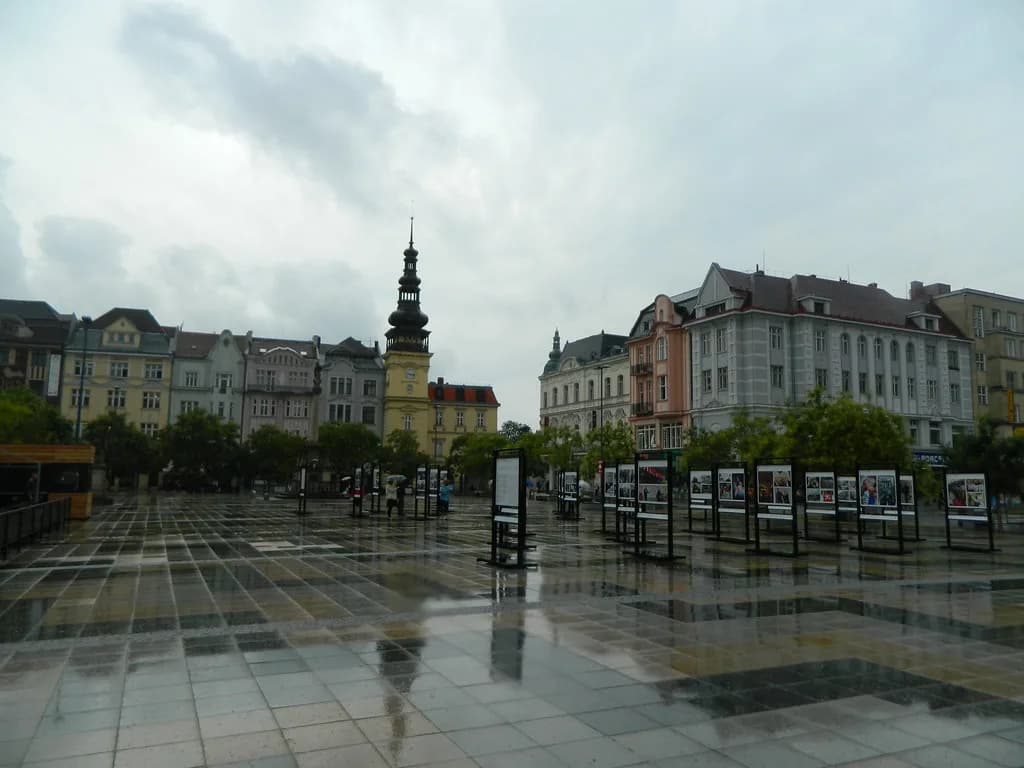
Masaryk Square in Ostrava: A Visitor's Guide to the Old Town Center
Masaryk Square (Masarykovo náměstí) is the central square of Ostrava and the natural place to start a walk through old Moravská Ostrava, and wandering it costs nothing. Use it as an orientation point: read the monuments, find the Old Town Hall tower, then branch out into the surrounding streets. This guide covers what stands on the square, how it got its odd shape, how long to allow and what sits within a short walk.
Come with modest expectations and the square rewards you. It is a working city square of shops, cafés and restaurants rather than a museum-piece plaza, and its pleasures are small and specific: a tower chime, brass plaques set into the paving, a fountain children run through in summer. Plan to pass through rather than to tour it, and give the interior sights their own time.
Where Masaryk Square sits in Moravská Ostrava
The square forms the center of Moravská Ostrava, the historic Moravian part of the city on the left bank of the Ostravice river. Shops, cafés and restaurants line it, with the Old Town Hall among them. Coming from the main station or from the New City Hall (Nová radnice) Ostrava, you are heading for this cluster of streets in the old core, not the industrial north of the city.
Treat the square as the hinge of a half-day in the center. The Cathedral of the Divine Saviour (Katedrála Božského Spasitele), Ostrava is close enough to combine with a square visit on foot, and the wider set of city sights is mapped out in Ostrava Attractions: 5 Visitor Guides. That makes Masaryk Square a practical first stop rather than a destination in itself.
The square's address is given simply as Masarykovo náměstí, 702 00 Ostrava. Trams and buses serve the center, and the city's transport search tools will match a connection to your arrival point; confirm times for the day you travel rather than relying on a remembered schedule.

Why the square is L-shaped
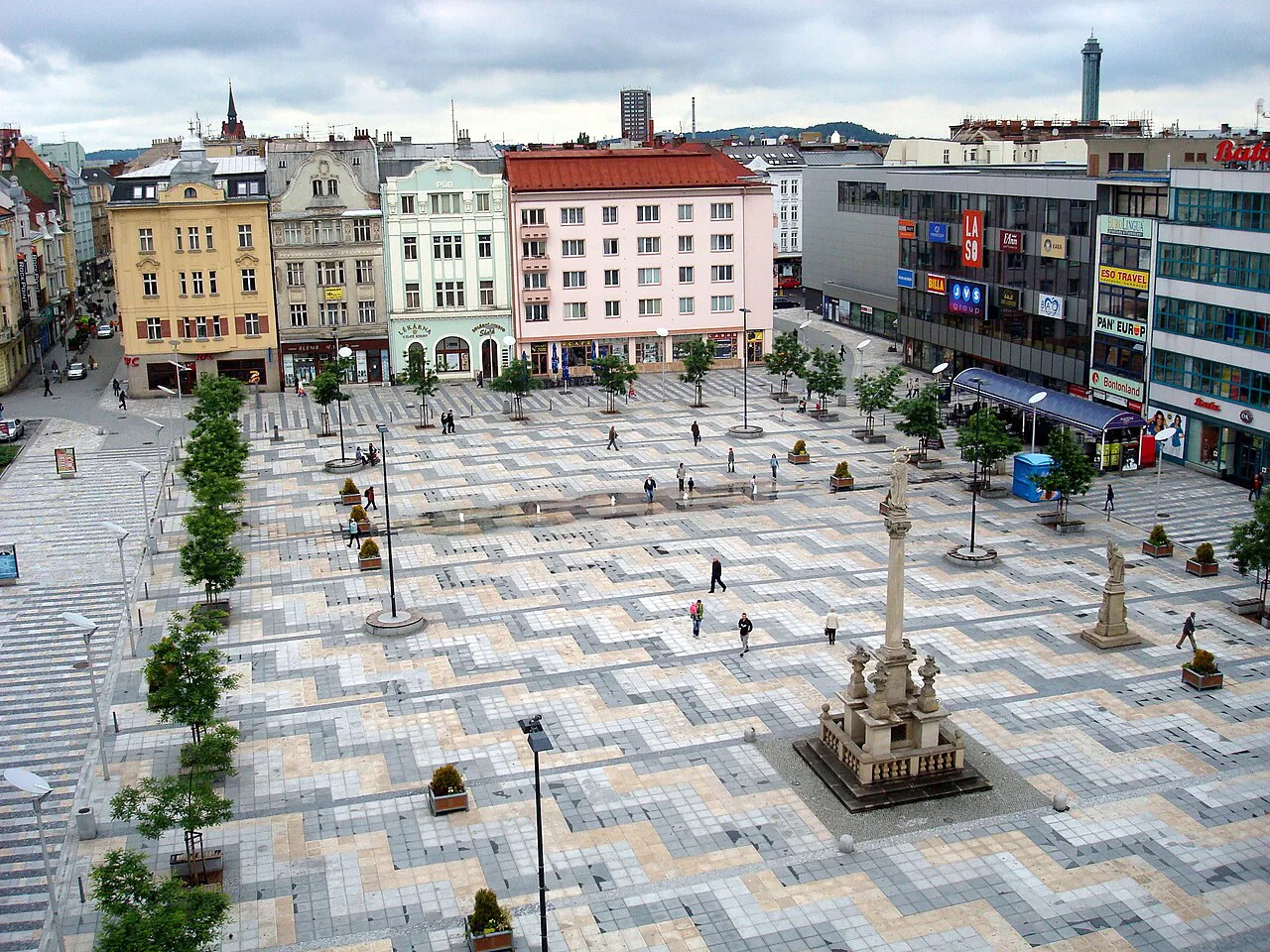
The square began as a rectangular medieval marketplace and is now an irregular L-plan. The change came from traffic: after iron production started at the Vítkovice works in 1829, carts struggled through the center, and in 1840 the town council decided to cut a new street through the middle of the main square, sacrificing three burgher houses to do it.
That street, later called Hlavní and now 28. října, was built in 1841–1842. It straightened the road line and improved the approach to the Ostravice bridge, leaving the square with the bent footprint you see today. The two arms of the square are the two halves of what was once a single open market space.
The Old Town Hall and Ostrava Museum
The Old Town Hall (Stará radnice) is the square's most substantial building, and it houses the Ostrava Museum with a historical exhibit on the city. The museum tower carries a chime that rings out over the square, the best reason to linger rather than walk straight across. For the exhibits themselves, the Ostrava Museum (Ostravské muzeum) guide covers what is inside.
The building anchors a visit: stand on the square, find the tower, and work outward from there. The museum sets its own opening days, ticket prices and any charge for tower access, so confirm those details with the museum before you build a day around going inside. The square outside stays free and open at all hours.
The Marian column and St. Florian
Two religious monuments dominate the open space: a column and a statue of St. Florian, with the column reading as the square's central vertical marker. St. Florian, the patron associated with fire and firefighters, has stood through changing political weather, and for years his statue was replaced by a figure of a militiaman with a rifle on his back.
Circling these monuments takes a few minutes but repays a closer look at the bases and inscriptions, which carry more history than the figures themselves. From the eastern side of the open space the column and the Old Town Hall tower line up, giving the classic view of the square.
T. G. Masaryk under the arcade
In a corner of the square, beneath the arcade that leads toward the Ostrava Museum, stands a statue of Tomáš Garrigue Masaryk, the first Czechoslovak president, who visited the spot. It is easy to miss because the arcade shadows it and foot traffic passes close by. Look for it as you head toward the museum entrance.
The arcades themselves shape the experience of the square, framing the shops and cafés and giving the place a sheltered, pedestrian character in wet weather. Walking the full circuit takes only a few minutes and shows you the square from several angles without committing to any one sight.
The pavement fountain and the brass plaques
A modern fountain in the central part of the square jets water directly out of the paving, and in summer children use it as a place to cool off. The square has been repaved in stone, and set into the paving are brass plates marking thirty key milestones in the city's history. Most visitors walk over them without noticing.
Hunting the plaques is the square's best low-effort activity, and it gives structure to a wander that otherwise ends in five minutes. Read them in sequence if you can find the starting point, or stop at the ones that catch the light. Together with the fountain, they make the paving itself worth attention.
Markets and seasonal life on the square
The square was a market ground in the Middle Ages, when it held a right to a sixteen-day market, said to have been granted by Charles IV in 1362. Today the market tradition survives mainly in the pre-Christmas period, when stalls return to the square. Everyday life is otherwise cafés, shops and people crossing between streets.
If a market is part of your reason for coming, the city's own event listings are the place to confirm what is running during your dates, since the calendar shifts from year to year. Arriving on a market morning changes the square from a thoroughfare into a place to stand still, which repays planning if you enjoy that atmosphere.
How long Masaryk Square takes
Give the square itself twenty to thirty minutes: enough for the column, the Masaryk statue, the fountain, a scan of the brass plaques and a pause for the tower chime. Add an hour or more if you go into the Ostrava Museum, since the historical exhibit is the one indoor sight actually on the square. Anything beyond that is time spent in the surrounding streets.
The honest trade-off is that the square is a starting point, not a headline sight. Visitors expecting a grand Austrian-style plaza may find it modest. Treat it as the place where old Moravská Ostrava makes sense, use it to orient yourself, and spend the bulk of your day on the city's larger attractions.

What to pair with the square nearby
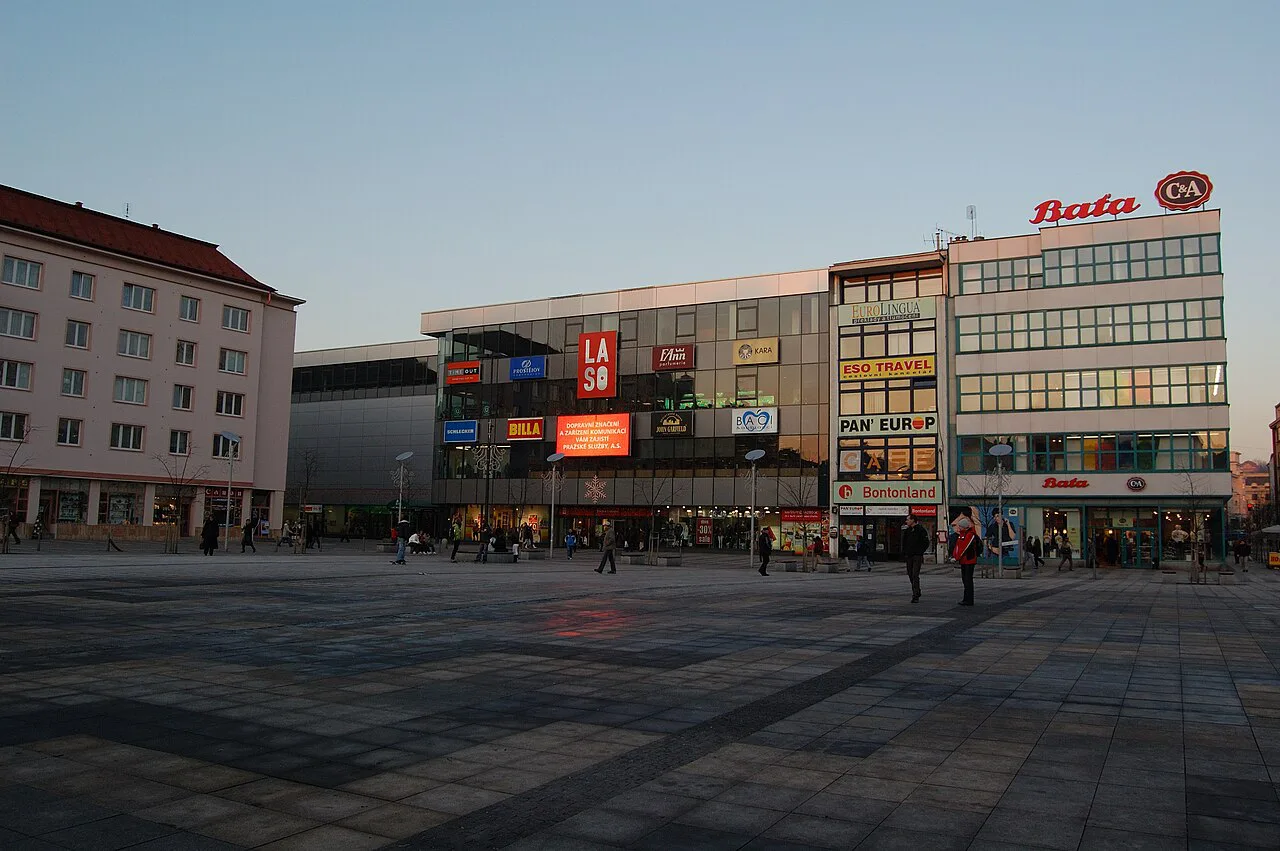
The New City Hall in Ostrava is the obvious architectural contrast, a later and far taller civic building within walking distance of the old square. Pairing the two gives you the city's two civic centers in one loop. For a longer day, Silesian Ostrava Castle (Slezskoostravský hrad) lies across the river and works better with a tram or bus than on foot from the square.
The Ostrava museum in the Old Town Hall is the tightest pairing, since it sits on the square and needs no travel time. Build the day as museum first, square second, then a walk out through the arcades toward the cathedral, and you have covered the old center in a few hours without rushing.
Which order to see the old center
Start at Masaryk Square, find the Old Town Hall tower and the brass plaques, and let the square do its job as an orientation point for Moravská Ostrava. Go inside the museum if the historical exhibit appeals, then walk out to the cathedral and, if you have the afternoon, take transport to Silesian Ostrava Castle.
The square asks little of you: no ticket, no queue, no fixed schedule. Its value is positional and cumulative, the monuments and paving details adding up to a picture of how a market square became a modern city center. A short, attentive stop is the right amount.
Explore more Ostrava guides
Frequently Asked Questions
Why is Masaryk Square an unusual shape?
It was originally a rectangular market square. In 1840 the town council decided to cut a new street through its middle to ease traffic after the Vítkovice ironworks opened in 1829, and the street built in 1841–1842 left the square with its present bent L-plan.
What is the fountain in the middle of Masaryk Square?
It is a modern fountain set into the paving of the central part of the square, sending jets of water straight up out of the ground rather than from a raised basin. In summer children use it to cool off, which makes it one of the liveliest corners of the square on a hot afternoon.