
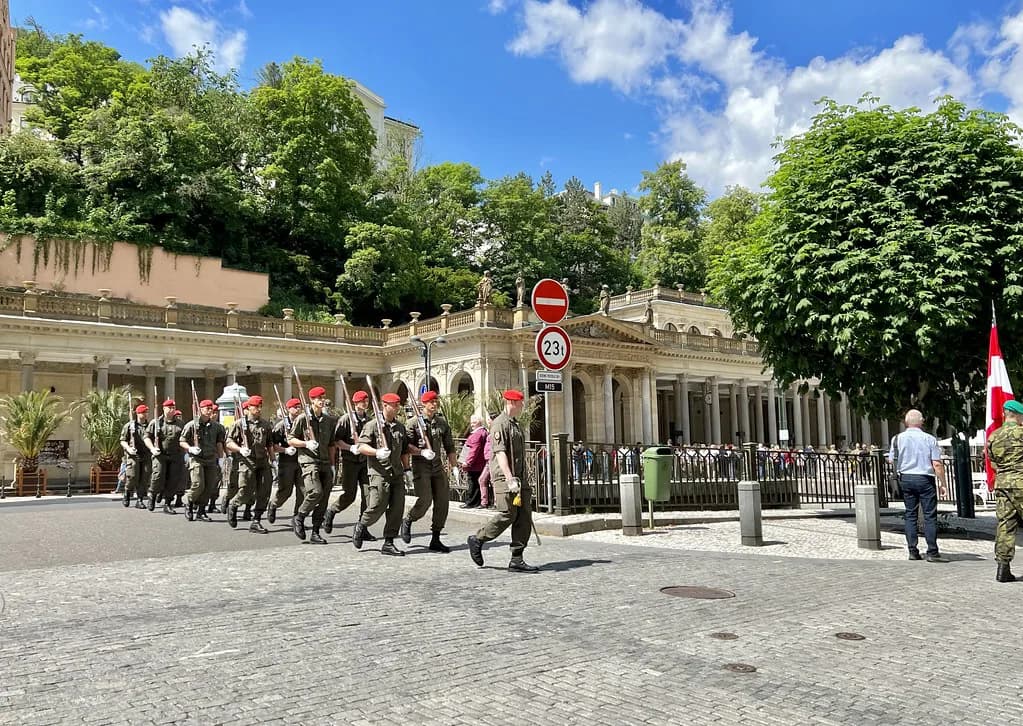
Mill Colonnade (Mlýnská kolonáda) in Karlovy Vary
The Mill Colonnade in Karlovy Vary is the one colonnade most visitors remember: a 132-meter neo-Renaissance hall by architect Josef Zítek, its roof carried on 124 Corinthian columns and its interior serving six named mineral springs. It anchors the central spa walk, and you can see the building and taste its springs in about 20 to 30 minutes, or give it half a day if you also work through the town's other four colonnades. This page covers what stands under the roof, how the visit works in practice, and what sits within a short walk, with the wider set of Karlovy Vary Attractions: 9 Visitor Guides as the place to plan the rest of the town.
What the Mill Colonnade is and why it anchors the spa walk
Karlovy Vary's colonnades are the town's public face: covered promenades built over the mineral springs so that patients and visitors can drink and walk whatever the weather. The Mill Colonnade, known in Czech as Mlýnská kolonáda, is described as the most popular of them, which makes it the natural starting point for a walk through the spa center. It is a working piece of spa infrastructure rather than a museum piece, so the atmosphere is a steady flow of people with small porcelain drinking cups moving from spring to spring.
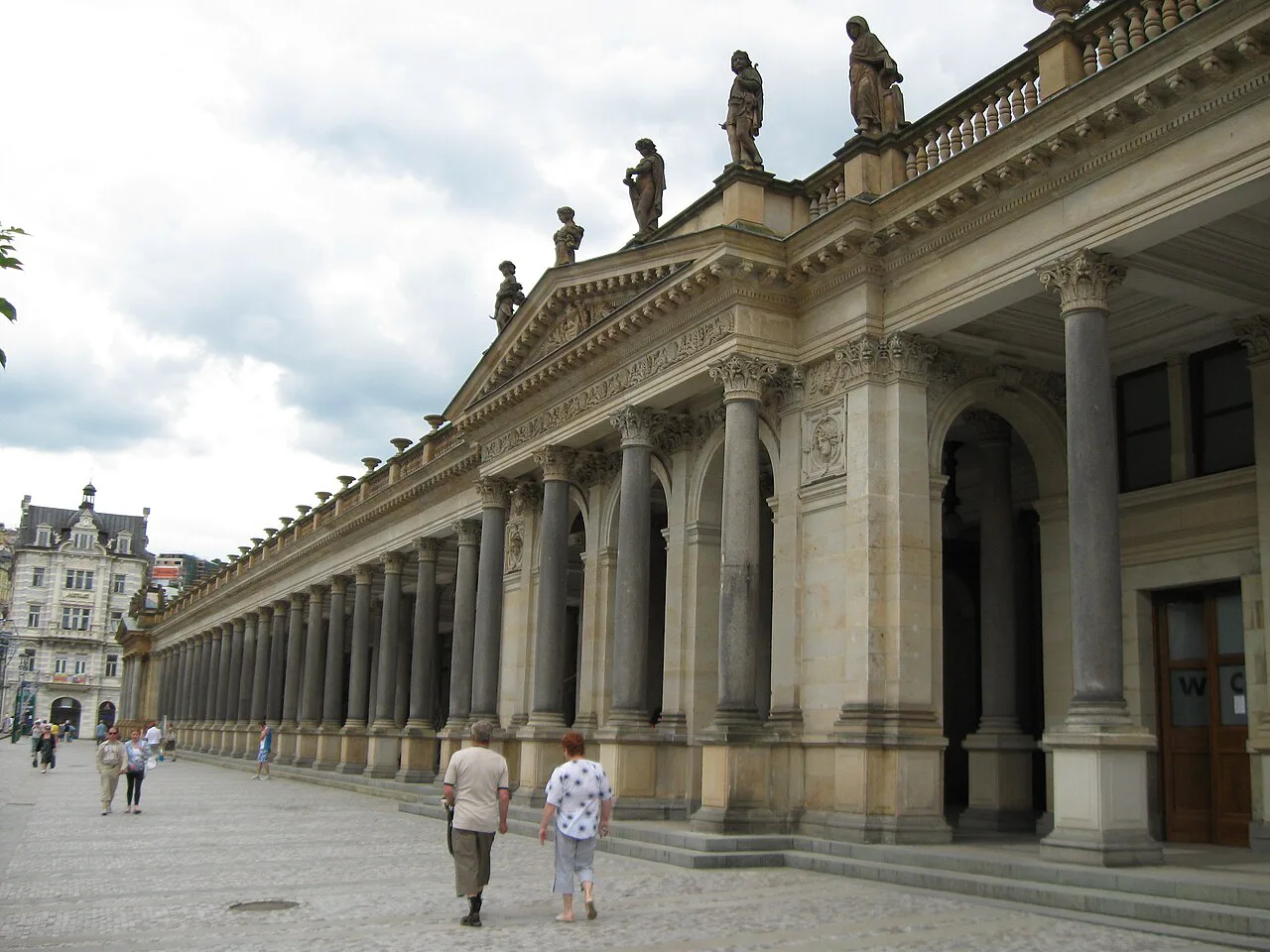
The colonnade dates from 1881 and was designed in the neo-Renaissance style, with statues and sculptural decoration on the structure and a long, airy interior open at the sides. That combination of a 19th-century promenade hall and an active drinking cure is what distinguishes a visit here from ordinary sightseeing: you come for the architecture, but you stay for the springs.

Where it sits in Karlovy Vary and how to reach it
The colonnade stands in the spa center, and the main colonnades sit within a short walk of one another, with the Hot Spring Colonnade at the upper end of the promenade and the Park Colonnade at the other. Trains from Prague run to Karlovy Vary station, and from there local transport or a taxi brings you into the center; the spa core itself is compact and best covered on foot, so once you arrive you will not need another ticket to move between colonnades.
Karlovy Vary works better as a stop of a night or two than as a rushed there-and-back, because the spa center rewards a slow morning rather than a tight schedule. The walk from the town center hotels and guesthouses to the Mill Colonnade takes only minutes, which is why so many visitors pass through it several times during a stay.
The building: 132 meters, 124 Corinthian columns, Zítek
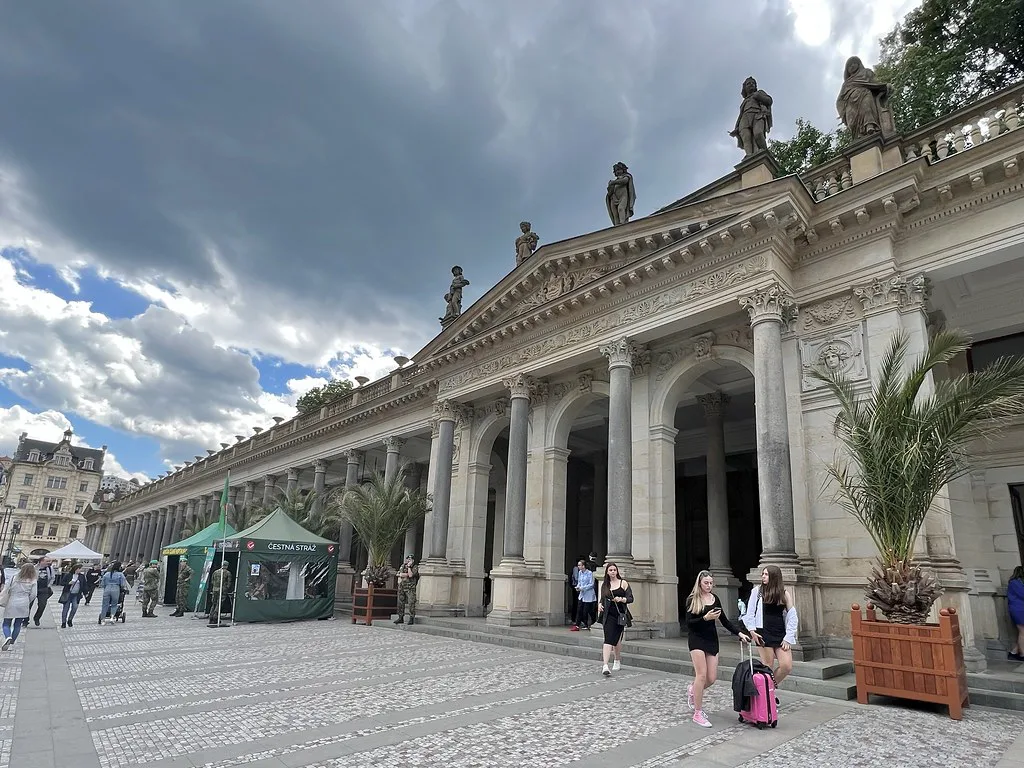
The Mill Colonnade is 132 meters long, and its roof is supported by 124 Corinthian columns. Zítek's neo-Renaissance design gives the hall a rhythm of columns and arches that reads as architecture first and shelter second, and the statues and sculptures on the structure reward a slow pass rather than a quick photo. The colonnade is also a good orientation point in the spa center, with the promenade in front of it running through the heart of town and the hillside hotels rising above.
Because the hall is open along its sides, the experience changes with the light: the columns read differently in the morning and the middle of the day brings the heaviest foot traffic along the promenade. If you want to study the architecture without a crowd around you, aim for the early hours and leave the midday promenade to the drinking-cure regulars.
The six springs inside: Skalní, Libuše, Wenceslas I and II, Mlýnský, Rusalka
Under the Mill Colonnade roof you will find six springs: Skalní (Rock), Libuše, Prince Wenceslas I and Prince Wenceslas II, Mlýnský (Mill) and Rusalka. Each has its own spout along the hall, so you can taste them in sequence as you walk the length of the colonnade. Knowing the names in advance helps you decide which taps to try rather than simply following the nearest crowd.
Each spring has its own spout and its own character, and Czech spa practice treats them as different medicines rather than variations on the same water. If you are following a drinking cure, the spa doctor's prescription decides which springs and how much; if you are simply tasting, a small cup and a few sips at each spout is the usual approach.
How the drinking cure works and what tasting involves
The drinking cure is the reason these halls exist: patients take measured amounts of specific mineral waters at set times of day, walking between springs as part of the routine. Visitors who are not on a cure can still be in the colonnade as a public promenade, and the spouts are set at a convenient height with space to stand and sip. If you plan to sample the water, bring a spa cup or buy one in town, take a small amount at each spring, and treat the walk between them as part of the experience rather than dead time.
The mineral water is warm and strongly mineral in taste, and not every spring will suit every palate; that is normal, and the point is to sample rather than to finish a full cup at each stop. Etiquette is simple: wait your turn at the spout and keep the promenade clear for patients walking their prescribed route.
How much time to allow and when to come
Give the Mill Colonnade itself 20 to 30 minutes: enough for the length of the hall, a look at the columns and statuary, and a taste at each of its springs. Add the other four colonnades and you have a comfortable half day in the spa center, which is the realistic unit for planning rather than an hour snatched between other stops. Because everything sits within a short walk of everything else, you can order the visit around your own pace and the weather.
Early morning is the calmest window and also the most characteristic, since the promenade fills with people taking their cure before breakfast. Midday brings the tour groups and the heaviest flow along the colonnade, and late afternoon lightens again. The colonnade functions as a public promenade over the springs rather than a gated sight with a turnstile, so plan for the time it takes to walk the hall and taste at the spouts.
The other Karlovy Vary colonnades within a short walk
Four more colonnades complete the circuit, and each has its own date and spring list, which makes a short walk through them a compact lesson in spa architecture. The Park Colonnade (Sadová kolonáda), dated 1880, serves the Snake (Hadí), Park (Sadový) and Freedom (Svoboda) springs.
The Market Colonnade (Tržní kolonáda) dates from 1883 and was built as a temporary wooden structure in a Swiss style; it survived and stands today after reconstruction, serving the Market and Charles IV springs. The Chateau Colonnade (Zámecká kolonáda) followed in 1913, designed by Ohmann, with an upper and lower section and the Upper and Lower Chateau springs.
The circuit closes at the Hot Spring Colonnade (Vřídelní kolonáda), built in 1975 around the Vřídlo spring, the hottest and most abundant in town at 72 °C. Its underground holds the technical plant that feeds the springs and a tour trail through it.
Nearby stops: viewpoints, glass and the town's museums
Beyond the colonnades, the spa center is ringed by lookout points, gazebos and small buildings set on the wooded hills, which makes a short climb after the promenade a natural pairing with the Mill Colonnade. The town's two best-known visitor attractions, the Moser glassworks and the Jan Becher Museum in Karlovy Vary, are listed among the Karlovy Vary region's sights and are the obvious pairings with a half-day in the center.
The Jan Becher Museum in Karlovy Vary covers the history of the Becherovka herbal liqueur and draws visitors who want the town's other famous product alongside its water. If glass is more your interest, the Moser glass museum and works tour make a good counterpoint to the colonnades, and both can be fitted around a promenade walk without much extra travel.
The Mattoni Museum rounds out the local-brand trio with the story of the Mattoni mineral water business and its founder, Heinrich Mattoni, dating to 1873. The Grandhotel Pupp, the grande dame of the spa center, is a landmark in its own right and a convenient orientation point when you are working out how the promenade connects to the rest of town.
Practical notes on tickets, hours and crowds
Treat the Mill Colonnade as a public promenade you walk through rather than a ticketed sight: the visit is about the hall, the springs and the walk between them, not about a timed entry slot. Where a specific opening or closing time matters for your day, check it at the town's information office or the venue's own notice before you build a schedule around it. For the museums and glassworks, book and confirm timing directly with each venue, since tours run on their own schedules rather than the colonnade's.
Crowds follow the cure and the tour buses: the promenade is busiest around the middle of the day, when groups move through the spa center in waves. If you want the columns and the springs with room to stand, come early and save the museum stops for the busier hours.
Build the colonnade walk around the Mill Colonnade
Start at the Mill Colonnade, taste its six springs, then work through the Park, Market, Chateau and Hot Spring colonnades in whichever order your morning allows. Budget half a day if you want the architecture, the springs and one museum; the Mill Colonnade itself takes about 20 to 30 minutes.
Explore more Karlovy Vary guides
Frequently Asked Questions
Do you need a ticket for the Mill Colonnade in Karlovy Vary?
It is a covered public promenade over the springs, so the visit is a walk-through of the hall and its spouts rather than a timed entry slot. Guided tours, tastings or museum stops elsewhere in the spa center have their own arrangements, so confirm those with the venue.
Which springs are served at the Mill Colonnade?
Six springs are linked to the Mill Colonnade: Skalní, Libuše, Prince Wenceslas I and II, Mlýnský and Rusalka. Each has its own spout along the hall, so you can taste them in sequence as you walk the length of the colonnade.
How long does a visit to the Mill Colonnade take?
Allow 20 to 30 minutes for the hall, its columns and the springs at a relaxed pace. Add the other four colonnades in the spa center and the visit stretches to a comfortable half day on foot.