
Valdštejnské Houses in Liberec: What to See at Větrná Alley

The Valdštejnské Houses are Liberec's oldest surviving buildings, and you see them from the street rather than on a guided tour. Count on about ten minutes in Větrná Alley to take in the narrow lane and the three half-timbered facades. This page covers where the lane sits, what to look for in the building fabric, when the interiors open, and how the stop fits into the old center of Liberec.
The honest trade-off is that this is a five-to-fifteen-minute sight, not a museum you tour. The payoff is architectural: a 350-year-old row that survived because a tight lane left no room to rebuild it, standing a few minutes from Liberec's main square.
Three houses in a lane about 50 meters long
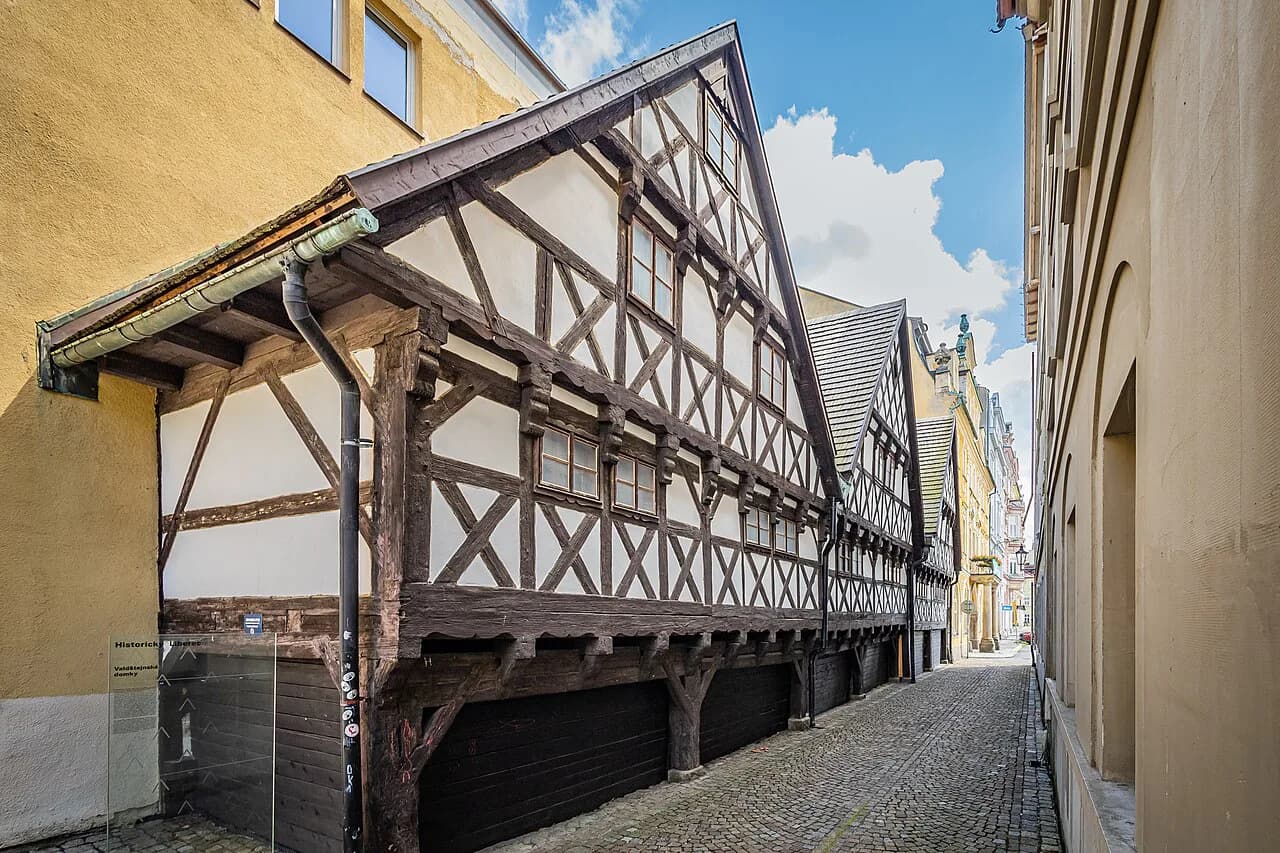
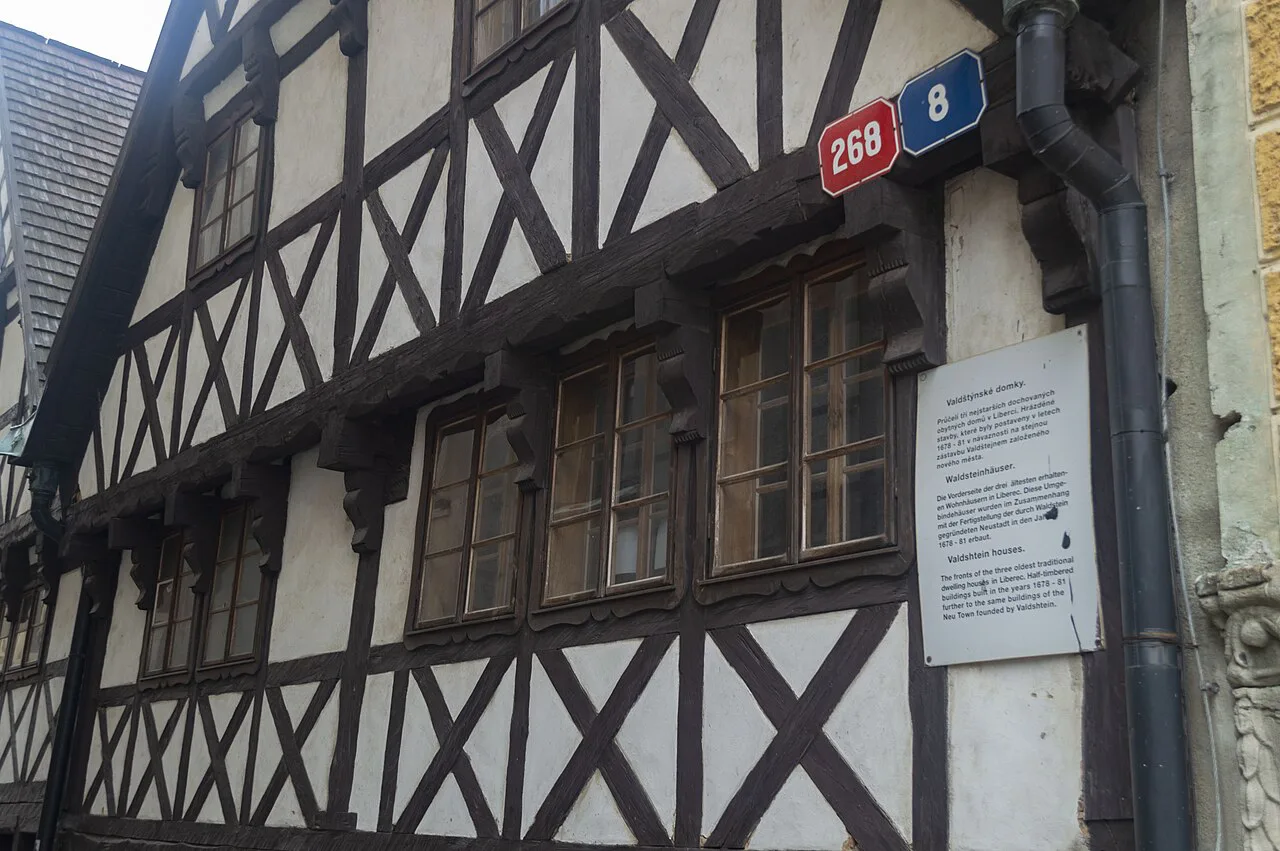
Czech Radio describes Větrná Alley as roughly 50 meters long and about three and a half meters wide, which puts it among the shortest and narrowest streets anywhere. Three connected houses fill it: partly timbered and partly masonry at ground level, with half-timbered upper floors and gables finished in clay. They were built in the late 17th century and have stood here for well over three hundred years.
The audioguide for the houses dates the ensemble to 1678–1681 and calls it the last surviving example in Liberec of the classic burgher house type that once lined the whole Nové Město quarter. That makes the row a fragment rather than a district: what you see is one complete lane where a neighborhood of similar buildings once stood.

Where the houses are and how to reach them
Větrná Alley belongs to the Nové Město quarter, now centered on Sokolovské náměstí, and the houses back onto the building of the Střední průmyslová škola stavební, the technical secondary school that has long looked after them. The school entrance is the doorway the occasional exhibition uses, so orient yourself by that building and slip into the lane beside it.
Since the lane sits inside the old street grid, you reach it on foot from Liberec's center; the broader Liberec Attractions: 4 Visitor Guides map out the surrounding sights. Train travelers arriving in Liberec walk or ride into the center and approach from there. The houses are not routinely open, so plan around the exterior view from the lane itself.

What to look for in the building fabric
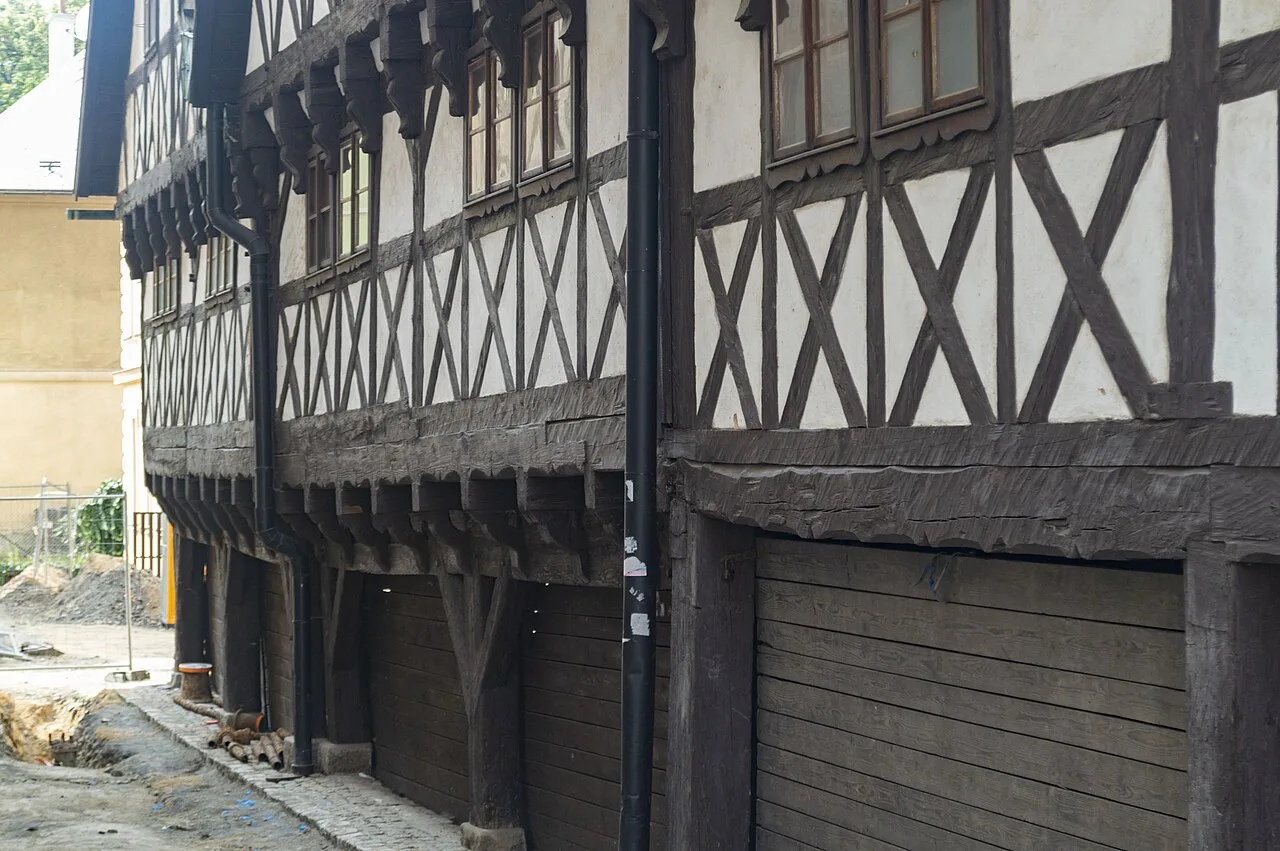
Look low first: the ground floor mixes timber framing with masonry, and the upper story and gables carry timber framing with a clay fill. Low ceilings, heavy wooden beams and small windows sit behind the facade, which is why the interiors feel older than the street suggests. The lane is tight enough that you read these details from a couple of meters away.
Photographs of the row show a plain, unrenovated exterior rather than a museum front, so plan your look around the projecting upper floors, the modest windows and the roofline. There is no street-side labeling, which is part of why the view reads as a piece of the old town rather than an exhibit.

Why the houses survived
Radek Cikl, director of the technical school, explains that the lane hid the houses well enough that no owner tried to enlarge or rebuild them as masonry buildings rose around them. The quarter grew as Albrecht of Valdštejn extended Liberec with the New Town, today's Sokolovské náměstí, to supply cloth for his troops. The houses eventually took his name, long after his death.
Architect Svatopluk Technik is credited with keeping the most valuable parts of the houses intact, and a portrait of him appears inside. That conservation history explains the current state of the row: a preserved fragment rather than a restored showpiece, with the lane itself doing much of the work of protecting it.
A pub called U Města Petrohradu
The houses were not only weavers' homes: one of them held a pub named U Města Petrohradu, an odd name that translates as At the City of St. Petersburg. The detail makes the lane easier to picture as a working street rather than a monument. Keep it in mind as you look at the facades, since the trade inside changed while the timber frame did not.
Interior access and the small exhibition
The interiors are not routinely open, so do not plan the trip around getting inside. The documented opportunity is the Dny evropského dědictví (European Heritage Days) around the start of September, when the houses open to visitors. The school also keeps an improvised exhibition hall reached through its building, with photographs and plans tied to the New Town and to the houses themselves.
Opening hours for that exhibition and any entry charge for Heritage Days are set by the school, so confirm them with the school or the local heritage office before planning a September visit. On an ordinary day, treat the exterior as the whole experience and be pleasantly surprised if a door is open.
How long to allow and how to pair the stop
Budget five to fifteen minutes for the lane and the facades; the view is compact and the street short. The stop works best as one piece of a walk through Liberec's old center rather than a destination on its own. Pair it with a longer look at the Liberec castle or an hour in the Liberec botanical garden if you want to fill a morning.
The Church of St. Anthony the Great in Liberec sits among the sights that fit the same walk through the center. Allow the lane its few minutes, then move on: the reason to come is the near-350-year-old timber row, and it delivers that quickly.
Getting there from Prague and fitting it into a route
Liberec sits in northern Bohemia, and the practical approach from Prague is by road or direct rail service into the city, then on foot into the center. Check current departure times and fares with the national rail operator or a bus line before you set out, since schedules change by season. The houses sit minutes from the main square, so no local transport is needed once you arrive.
Drivers passing through Liberec can park in the center and walk the lane in the same stop as the town hall and the surrounding streets. Either way, the visit rewards a traveler already in town rather than justifying a detour on its own.
Should Větrná Alley be on your Liberec list?
Yes, if you are already in Liberec and like old building fabric: the lane and its three houses take minutes to see from the street. Skip it only if you are pressed for time and want interiors, since those open on the Heritage Days schedule rather than daily.
Build the stop into a walk that includes the Liberec Castle (Liberecký zámek) and the center, and leave the lane as the small, quiet moment between bigger sights. Plan a September visit only after confirming Heritage Days access with the school.
Frequently Asked Questions
What are the oldest houses in Liberec?
The Valdštejnské Houses in Větrná Alley are the oldest surviving buildings in Liberec, according to the director of the technical school that looks after them. The audioguide dates the row to 1678–1681.
How wide is Větrná Alley?
Czech Radio puts the lane at roughly 50 meters long and about three and a half meters wide, placing it among the shortest and narrowest streets in the world. That tight width is also why the houses were never enlarged.